
News
CSO urges Tinubu to sign bill on reviewed retirement age for NASS staff into law

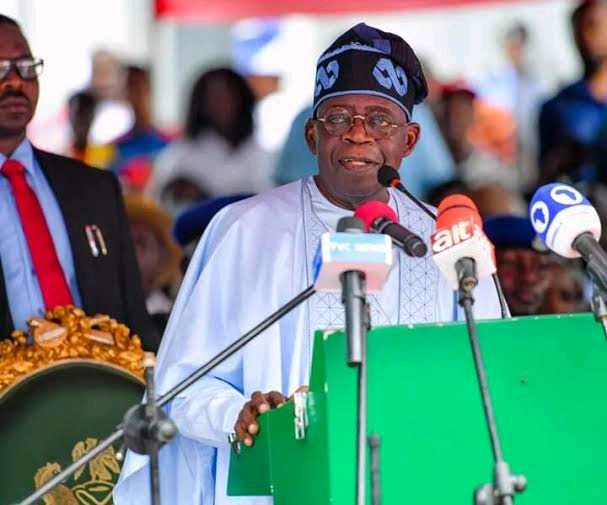
A Civil Society Organization has called on President Bola Ahmed Tinubu to sign a Bill which effected an upward review in the retirement age of National Assembly staff into law.
The National Assembly recently passed a Bill which seeks to add five years to the retirement age of the National Assembly staff
According to the CSO, Alliance for Credible Legislative Conduct, at a Press briefing by its Chairman, Comrade Clement Afuye, said assent to the Bill would help strengthen the National Assembly as an institution which is pivotal to the success of any democracy.
He said that despite misconceptions about the Bill, the Senate and House of Representatives had acted patriotically by passing a critical legislation to address the manpower needs of the legislature.
The group said it had become imperative to call on patriotic Nigerians and President Bola Tinubu to join hands to defend the nation’s topmost legislative institution from “powerful vested interests and predators.”
Afuye said: “Considering the enormous work inherent within the Parliamentary system, especially when compared to advanced democracies and the competencies and experience required to perform arduous legislative tasks, adding extra five years to the tenure of staff of the National Assembly will never exacerbate unemployment situation in the country; it will rather stabilize the parliament, deepen its procedures and practices and increase its capacity to deliver for the good our democracy and country.
“The added years, in our view, would help reduce cost, curb brain drain, retain critical mass of competent and experienced staff and ensure optimum productivity and effectiveness of the National Assembly’s bureaucracy.
“It is based on the strength of the above that we passionately use this medium to call on President Bola Ahmed Tinubu, a former Senator of the Federal Republic of Nigeria, to append his signature to this Bill.
“Signing the Bill will be an added cap on his reforms efforts and a testament to his progressive and effective leadership style aimed at repositioning the nation’s economy and democracy as a critical member of the global community.”
The group added: “For the avoidance of doubt, the Legislature as the only symbol of democracy in Nigeria is still evolving and trying to develop its practices and procedures compared to the other two Arms of Government.
“Let us recall that since 1979, when Nigeria had its transition from parliamentary to presidential system of government, the bureaucratic structure of the National Assembly has since been evolving and struggling to stabilize in the face of competing challenges.
“Another setback was the Intermittent military interference in governance and suppression of the legislature during the reign of the military governments and the National Assembly had to contend with such debilitating scenario for decades.
“It may interest you to note that until the return of democracy in 1999, and the creation of National Assembly Service Commission (NASC) in year 2000, the National Assembly’s bureaucracy was not fully independent.
“At this juncture, we want to make it very clear that, whatever will make the National Assembly to operate to its fullest statutory capacity in tandem with other parliamentary democracies globally cannot be silenced or truncated by any selfish group or individuals…”


By Adeko Ukpa
Former Deputy National Publicity Secretary of the All Progressives Congress (APC), Comrade Timi Frank, has urged President Bola Tinubu to apologise to former Vice-President Atiku Abubakar and Nigerians over the removal of petrol subsidy, accusing the Federal Government of adopting an intervention similar to a proposal it had previously criticised.
Frank, in a statement issued in Abuja on Friday, was reacting to the Federal Government’s announcement of a 30-day petrol discount at Nigerian National Petroleum Company Limited (NNPCL) retail outlets, with priority given to public transport operators.
He argued that the temporary measure had exposed what he described as inconsistencies in the administration’s position on petrol subsidy, insisting that Nigerians deserved lasting relief from the economic hardship that followed the policy’s removal in 2023.
“We expect Tinubu and his government to first apologise to Atiku Abubakar for its previous attacks on his position to return fuel subsidy if voted into office as President.
“Secondly, he should commend him and thank him for what we consider an excellent proposal that could help address the current economic hardship facing Nigerians.
“Rather than dismissing his proposal, the government should recognise its potential to provide relief to Nigerians who are struggling with the prevailing economic situation.
“Any government genuinely committed to the welfare of the people should be willing to consider practical ideas that can ease their suffering, irrespective of who puts them forward,” he said.
The Federal Government announced the 30-day discount on Thursday as part of measures to cushion the impact of rising petrol prices.
The Minister of Finance and Coordinating Minister of the Economy, Taiwo Oyedele, said the arrangement was not a return to subsidy but an offer to sell petrol at cost for an initial period of 30 days.
Frank, who is the United Liberation Movement for West Papua (ULMWP) Ambassador to East Africa and the Middle East, however, questioned the distinction between the discount and the subsidy arrangement previously abolished by the administration, arguing that the new measure amounted to a reversal of its earlier hardline position.
“Simply put, Tinubu, who maintained a hardline stance on fuel subsidy removal, has gone back to his vomit,” he said.
He added: “The President must immediately apologise to Nigerians over the fuel subsidy removal now that he has realised his policy mistake, which has taken a huge toll on Nigerians economically since 2023.”
Frank also questioned whether the temporary intervention would provide meaningful relief to Nigerians who have struggled with rising transportation costs, food prices and shrinking purchasing power since the subsidy was removed.
He said the policy change in May 2023 had affected households and businesses across the country, with higher petrol prices feeding into the cost of transporting goods, running businesses and meeting basic household needs.
“For millions of Nigerians, the consequences of higher fuel prices have extended beyond the cost of filling a vehicle’s tank.
“Increased transport and logistics costs have put pressure on traders, manufacturers, farmers and small businesses, while households have had to contend with rising expenses for commuting, food and other necessities,” he said.
Frank argued that a 30-day discount could not reverse the cumulative effects of more than three years of economic pressure, particularly for workers and small-business owners whose earnings had struggled to keep pace with rising living costs.
He also raised questions about the scope and implementation of the intervention, including the number of NNPCL retail outlets participating in the scheme, the volume of petrol to be sold at discounted rates and the measures planned after the initial 30-day period.
According to him, the government must explain how the arrangement would provide sustained relief to transport operators, traders, workers and low-income households rather than offer a temporary reprieve.
The former APC spokesman said the latest development had also revived debate over Atiku’s proposal to restore petrol subsidy if elected president in 2027.
In August, Atiku reiterated his position on the issue, declaring: “On the question of subsidy, my position has not changed and will not change: I will restore it!”
The former vice-president had argued that Nigeria should use its resources to protect citizens from severe economic hardship.
The Presidency, however, challenged the proposal, questioning its fiscal and legal basis and asking how a restored subsidy would avoid the problems associated with the previous system.
Frank said the Federal Government’s latest intervention had vindicated Atiku’s call for a subsidy arrangement intended to cushion Nigerians against rising fuel and transportation costs.
“But now, having seen the light in Atiku’s proposal, Tinubu simply came down off his high horse and adopted the idea without any acknowledgments,” he declared.
He warned the President against expecting the temporary discount to erase public dissatisfaction over the economic consequences of subsidy removal.
“Nigerians are no fools. They know how their present economic predicament started with ‘fuel subsidy is gone’ in 2023. They will definitely use their votes to reclaim their country and set it on the path of economic progress come 2027,” he said.
Frank maintained that the central issue was not whether the government described its latest intervention as a discount or a subsidy, but whether it would deliver meaningful and sustained relief.
He called on the administration to explain how the measure would address the broader cost-of-living crisis and prevent households and businesses from continuing to bear the brunt of high energy and transportation costs.
He insisted that Nigerians needed a coherent, long-term economic response rather than a temporary intervention that would expire after 30 days.
By Adeko Ukpa
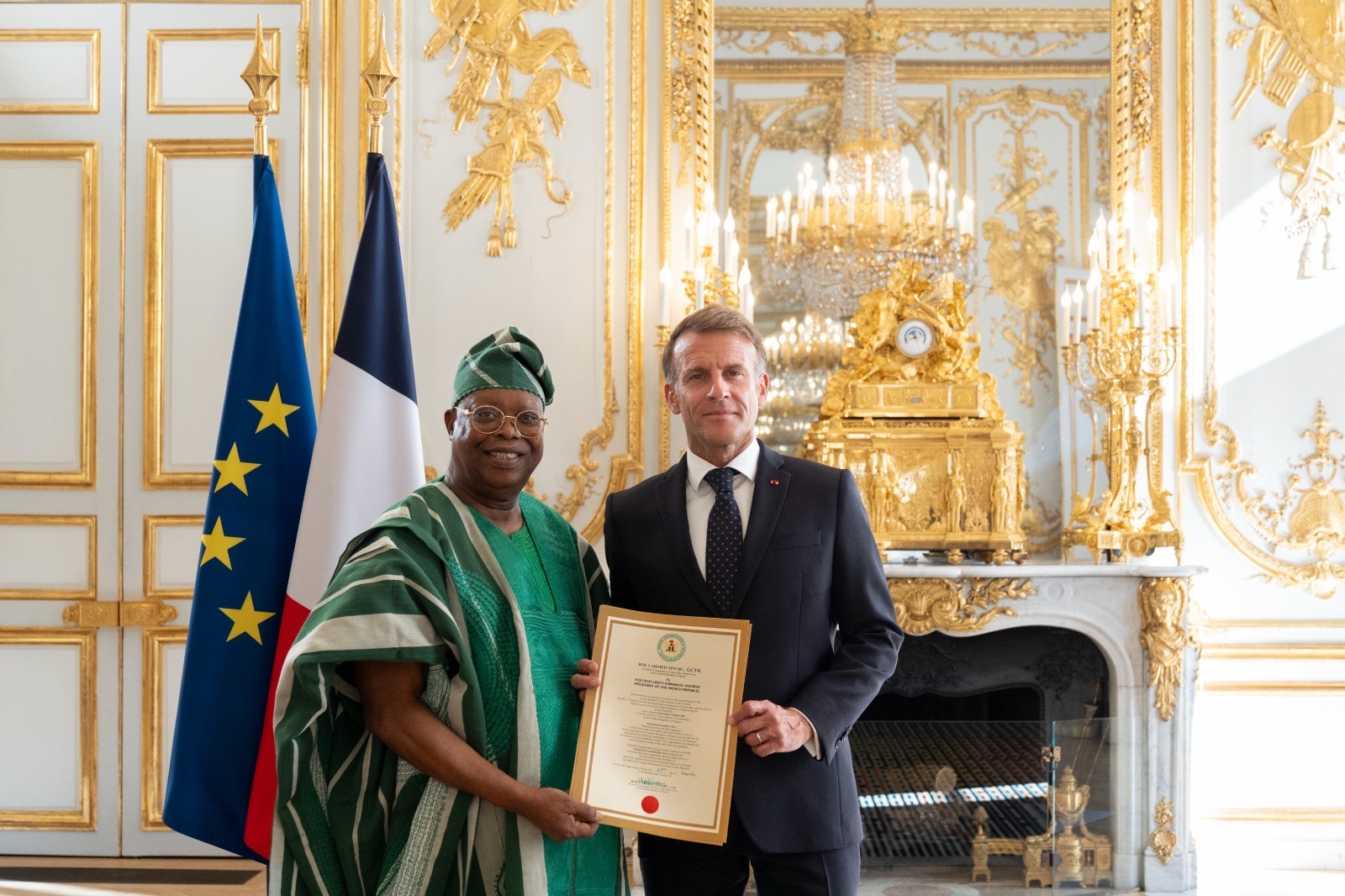
The 17th Ambassador of the Federal Republic of Nigeria to the French Republic, Ambassador Ayodele Oke, CFR has promised to recalibrate the ties between the two countries.
He also promised to give priorities to security, trade, and investment.
Oke unfolded his agenda while presenting his Letters of Credence to the French President, Emmanuel Macron at Élysée Palace in Paris.
CAPTION: The 17th Ambassador of the Federal Republic of Nigeria to the French Republic, Ambassador Ayodele Oke, CFR presenting his Letters of Credence to President Emmanuel at Élysée Palace on Monday. PHOTO: NIGERIA EMBASSY, PARIS
Envoy’s Priorities for France
A statement by the Nigerian Embassy in Paris said he pledged to uphold Nigeria’s values and reputation with clarity and credibility.
He said: “I am pleased to inform you that on 5 October 2026, I presented my Letters of Credence to President Emmanuel Macron and formally assumed my duties as the 17th Ambassador of the Federal Republic of Nigeria to the French Republic.
“The brief yet significant ceremony took place in the grandeur of the historic, iconic Élysée Palace, with its regal ambience.
“It underscored the compelling need to elevate and recalibrate the partnership between Nigeria and France.
“This means strengthening bilateral relations in security, trade, and investment, while upholding our values and reputation with clarity and credibility.
“It also means shaping conversations, securing advantages, protecting citizens, and promoting Nigeria’s national image.”

Stop Starting. Start Finishing: Why Continuity Is Strategically Important for Nigeria in 2027
by Mary Laniyan
“Stop starting. Start finishing,” is a popular agile transformation principle used to shift organisations away from measuring activity and toward delivering value and measurable outcomes. Governments are not corporations, but the underlying economic principle is comparable. In government, the stakes are infinitely higher, they have a human cost.
The cost is measured in the lives of ordinary people, the pain of making ends meet, the anxiety of raising a family, the frustration of being unable to find meaningful work, the loss of dignity that comes from being unable to be productive and self-reliant, and, above all, the uncertainty surrounding the future of an entire generation of young Nigerians. That is why I dare say this: Nigeria does not need another beginning in 2027. Nigeria needs continuity, discipline and the courage to finish what it has started.
The problem with perpetual beginnings.
By the time the presidential baton changed hands in 2023, the Nigerian foundation had deteriorated significantly. Consequently, regardless of who assumed office, there was always going to be a period of pain, if the genuine intention was to confront the structural problems that had bedevilled the country for decades.
Structural reforms are rarely painless.
Much like a house with serious structural defects, a fresh coat of paint may make the building look beautiful in the short term, but it does not fix the structural issues at the core of its foundation. Eventually, the underlying problems return, and often with greater consequences. Nigeria cannot afford to keep painting over structural cracks. Fixing the foundation requires something that our political system has historically struggled with, and that is continuity.
The tyranny of the “pet project.”
As we look towards 2027, I believe it is not too early to appeal to the conscience of our political elites to embrace a mindset of “continuity for impact” and move away from the political “pet project” mindset.
Every administration naturally wants to leave its own mark. There is nothing inherently wrong with that, but if we put Nigeria first and put on the hat of a relay race athlete, you win and Nigeria wins. Leaving your mark should not be more important than building on what already exists for a much needed outcome. A new administration arrives. A new set of priorities are announced. Existing programmes are renamed, abandoned, redesigned or simply starved of political attention. Years later, another administration arrives and starts the cycle all over again. The result is predictable, we become very good at starting and very poor at finishing and Nigeria pays the price.
Ajaokuta should never become normal.
I belong to a generation that still mourns the story of the Ajaokuta Steel Complex. Ajaokuta represents one of Nigeria’s most consequential industrial missed opportunities, not merely because a steel plant was never fully realised, but because of the industrial ecosystem that could have developed around it. A functioning integrated steel industry could have supported engineering, manufacturing, construction, machinery, transportation, mining and a range of downstream industries. It could have created skills, supply chains and industrial capabilities that would have outlived any single administration. That is the tragedy of Ajaokuta.
We did not merely fail to finish a project; we potentially failed to finish an industrialisation strategy that would have revolutionized Nigeria for a generation yet unborn.
And then there is Mambilla.
The Mambilla Hydroelectric Project represents another extraordinary missed opportunity. Nigeria has spent decades confronting one of the fundamental constraints on economic development, inadequate and unreliable electricity. We have repeatedly struggled to complete major projects capable of expanding the country’s power-generation capacity at scale.
Mambilla is a powerful reminder that infrastructure of national significance cannot be treated as the property of whichever administration happens to inherit it. If projects such as Ajaokuta and Mambilla had been successfully completed, integrated into the wider economy and properly maintained, I believe Nigeria’s economic trajectory could have been profoundly different. One finished project may not magically transform a nation, but it will create platforms upon which other opportunities can be built.
Continuity is not political loyalty, this is an important distinction. Continuity should not mean defending everything a previous administration did. It should not mean refusing to correct mistakes. It should not mean protecting failed policies because of political allegiance. Continuity means identifying what is strategically important to Nigeria, preserving what works, correcting what does not, and finishing what deserves to be finished.
A new administration should have the courage to say: This may not have been my project, but it is imperative that we finish it. That is the mindset we need. Imagine a Nigeria where successive administrations measured themselves not only by what they started, but by how many strategically important national projects they successfully completed. It is in this context that Hon. Minister Nyesom Wike comes to mind. He should be applauded for finishing a lot of projects that he didn’t start.
How do we make this work?
Every administration should have the opportunity to shine within a 20 to 30 year national development horizon, while plugging into a clearly defined Nigerian National Development Strategy that provides a consistent North Star.
The long-term strategy should set out where Nigeria wants to be in 20 or 30 years. Each administration should then be responsible for defining the specific priorities, reforms and measurable outcomes it will deliver during its tenure to move the country closer to that destination. The destination remains consistent; administrations compete on how effectively they move the country forward. This creates the right balance between continuity and accountability.
Let’s get Organised
“We are not outnumbered, we are out-organised.” The quote is widely attributed to human rights activist Malcolm X, I believe it resonates deeply with our context today. Nigeria is not short of people, ideas, talent, ambition or resources. We need government to create the conditions in which Nigerians can do more for themselves. Nigerians in my opinion, are the easiest to govern because of their resilience and grit. That is why 2027 should not simply be another political contest. It should be an opportunity to ask a more fundamental question: What must Nigeria continue, complete and institutionalise to leverage its people for a vibrant economy.
And if we genuinely want to change the trajectory of this country, perhaps the most important political and civic discipline we can embrace is also the simplest.
Stop starting.
Start finishing.
Mary Laniyan
Systems Performance Coach
-
 Opinion2 years ago
Anioma State: A Necessary Proposal Rooted in Strategic Advantage
-
 Opinion5 months ago
Ibileye’s Quiet Revolution at Federal University Lokoja
-
 Business & Economy2 years ago
NASENI, Qietur partner to build 3000 Housing Units for Staff
-
 Law2 years ago
Human Right and Law Enforcement in Nigeria: A Critical Analysis
-
 Business12 months ago
Lithium boom has reshaped Nasarawa’s economy, says Prof Haruna
-
 Education1 year ago
TVET will change Nigeria for good, says NABTEB Registrar
-
Education1 year ago
NABTEB Registrar advises automotive, locomotive Engineers to do more to diversify Nigerian economy
-
 Opinion1 year ago
Engr. Kawu: A Heroic Homecoming for a Man of the People