
International
Timi Frank condemns declaration of Paul Biya as winner of Cameroon’s presidential election


By Adeko Ukpa, Abuja
Former Deputy National Publicity Secretary of the All Progressives Congress (APC), Comrade Timi Frank, has strongly condemned the
declaration of Paul Biya as winner of the recent presidential election in Cameroon.
Frank in a statement in Abuja, described the announcement of the 92 year old Biya as an insult to democracy and a brazen fraud that must be rejected by all who believe in justice and freedom.
He said: “The so-called results announced by the regime are a fabrication and a clear subversion of the people’s will.
“The world must not stand by while democracy in Cameroon is strangled in broad daylight.”
He lamented that peaceful protesters who took to the streets to denounce the daylight robbery of their votes have been met with gunfire, brutality, and mass arrests.
“Innocent Cameroonians are being killed by their own security forces simply for demanding that their votes count.
“This bloodshed must end immediately. Those who ordered and carried out these killings must be held personally accountable before international law.
“The International Criminal Court (ICC) and the United Nations (UN) must investigate and ensure that justice is done.”
According to Frank who is the United Liberation Movement for West Papua (ULMWP) Ambassador to East Africa and Middle East, the African Union’s “shameful silence in the face of such blatant electoral robbery is a betrayal of its founding principles.”
He added: “By refusing to speak out or act, the AU is enabling tyranny and helping destroy democracy on the continent.
“It is this silence and hypocrisy that fuel coups and instability in Africa, when the people are denied peaceful paths to change, they are pushed to desperation.
“The time has come for the AU to choose between complicity and conscience.”
He called on the United States, the European Union, the United Nations, and all responsible nations to impose targeted sanctions on Paul Biya’s regime, “including travel bans, asset freezes, and suspension of military assistance.”
He added: “The international community must make it clear that those who rig elections, kill citizens, and destroy democratic institutions will pay a heavy price.
“Anything less would embolden other dictators across Africa to repeat this travesty.”
He insisted that the true winner of the Cameroonian election remains Issa Tchiroma Bakary; whose mandate reflects the genuine will of the people.
“The international community must recognise this fact and pressure Paul Biya to step down,” he said.
He urged Cameroonians not to surrender their future to a regime that survives on repression and deceit.
“To the brave people of Cameroon: your courage in the face of tyranny is a beacon of hope.
“Defend your mandate, stand for your democracy, but remain peaceful and united.
The world is watching, and history is on your side.”
According to him, if the world fails to act decisively now, it would set a dangerous precedent, “one that tells African leaders that rigging elections, silencing opponents, and murdering citizens come without consequence.
“This must not happen. The time to act is now. The world must stand with the people of Cameroon and make it clear that stolen elections and blood-stained power have no place in the 21st century,” he said.








….Former Foreign Affairs Minister calls for stronger continental integration, warns against discrimination among Africans
By Adeko Ukpa
Former Minister of Foreign Affairs, Yusuf Maitama Tuggar, has condemned the growing hostility against fellow Africans in parts of the continent, particularly South Africa.
He warned that xenophobia undermines the ideals of Pan-Africanism and threatens Africa’s collective future.
Tuggar said Africa could not genuinely pursue continental unity, economic integration and shared prosperity while citizens of one African country were subjected to discrimination, intimidation and violence in another.
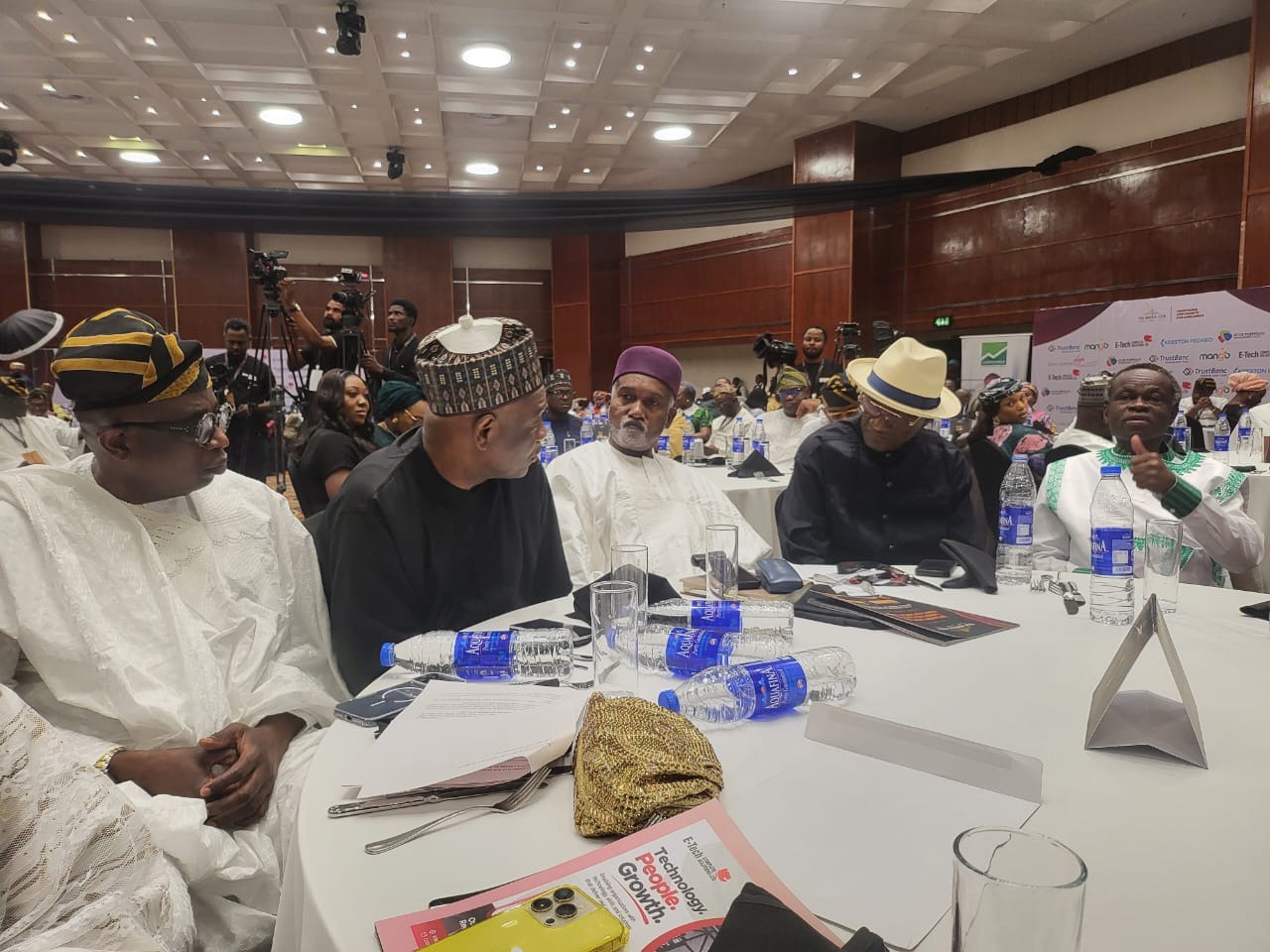
He spoke at the 2026 end-of-year event of The Bridge Club, where he served as chairman of the occasion.
The event featured renowned Kenyan scholar and Pan-African advocate, Professor P.L.O. Lumumba, as keynote speaker.
L-R: The President of The Bridge Club Lagos, Mr. Abdulhakeem Mustapha (SAN); the Executive Secretary, TETFUND, Arc. Sonny Echono; the Chairman of the occasion and a former Minister of Foreign Affairs, Amb. Yusuf Maitama Tuggar; a special guest, Mr Brodericks Arigbodi; and the Keynote Speaker, Prof. P.L.O. Lumumba at the end-of-the-year symposium of the club on Xenophobia and Pan-Africanism on Thursday at the Continental Hotel, Lagos.
The former minister, who reflected on Nigeria’s historical involvement in the struggle against apartheid in Southern Africa, said the country had made enormous sacrifices to secure the liberation of African countries from racist minority rule.
He recalled how Nigeria provided scholarships and other assistance to victims of apartheid, including South African students who survived the 1976 Soweto massacre.
According to him, Nigeria’s solidarity extended to Namibia, Angola and other African countries struggling against colonialism and racial oppression.
He said Nigerians of his generation grew up believing in African liberation and unity, making the current hostility against Nigerians and other black Africans in South Africa particularly difficult to understand.
Tuggar said: “These are but a very few of the reasons why Nigerians cannot fathom why they and other black Africans are being targeted in South Africa.
“Call it Afrophobia, which may be a better description than xenophobia, as non-black Africans appear to be exempted, or the more euphemistic framing of anti-migration protests, it is wrong and must be condemned.”
He described the development as particularly unfortunate at a time when African countries should be strengthening cooperation to improve their economic and political standing in the international community.
Tuggar, however, argued that understanding the historical and structural factors behind the hostility was necessary to addressing the problem, stressing that historical context should not be mistaken for justification.
He traced some of the roots of institutionalised segregation in Africa to colonial policies and the apartheid system, arguing that their psychological and social consequences continued to influence relationships within African societies.
The former minister said the continent needed intellectual rigour, historical understanding and stronger institutions to confront prejudice and other attitudes that undermine African solidarity.
He also identified economic integration and industrial development as critical elements of genuine Pan-Africanism.
According to him, Africa cannot achieve meaningful development by remaining a supplier of raw materials to the rest of the world while importing finished products.
He cited the vision of Nigerian development economist Adebayo Adedeji and other African intellectuals who advocated manufacturing, regional integration and the development of an African Economic Community.
Tuggar said the African Continental Free Trade Area (AfCFTA) offered an important opportunity to advance that vision by strengthening trade, industrialisation and the movement of goods and services across national borders.
He identified three important connections between economic integration and Pan-Africanism, including the need for free movement of labour as a foundation of an effective continental free trade system.
He said: “The path to Pan-Africanism is through the continental free trade area.
“As the father of capitalism, Adam Smith, once opined, the free circulation of labour is the foundation of any free trade system.”
Tuggar also expressed concern about the possible influence of external interests in fuelling anti-migrant sentiments, calling for greater scrutiny of organised anti-immigration campaigns and their sources of funding.
He warned that the relationship between Nigeria and South Africa remained too important to the continent’s future to be undermined by hostility and mutual suspicion.
He recalled South Africa’s support for Nigeria’s international engagements, including its efforts towards joining the Group of 20 (G20).
Earlier, President of The Bridge Club, Abdulhakeem Mustapha (SAN), said the theme of the event, Xenophobia Contradicts Pan-Africanism, reflected the urgent need for Africans to reconcile their commitment to continental unity with their treatment of fellow Africans.
Mustapha said Pan-Africanism must go beyond political declarations, diplomatic conferences and economic agreements to become evident in people’s attitudes and conduct.
He asked: “How can we genuinely aspire to a united Africa when an African is made to feel unwelcome, unsafe or unwanted in another African country simply because of nationality, ethnicity or origin?”
He added that Africa’s prosperity, security and dignity were interconnected and could not be achieved sustainably at the expense of another African country.
Mustapha urged members of the club and other stakeholders to promote tolerance, mutual respect and understanding across national and cultural boundaries.
The event brought together professionals, business leaders, diplomats and other distinguished guests to discuss the future of African unity and the responsibilities of citizens in building a more inclusive continent.
By Adeko Ukpa
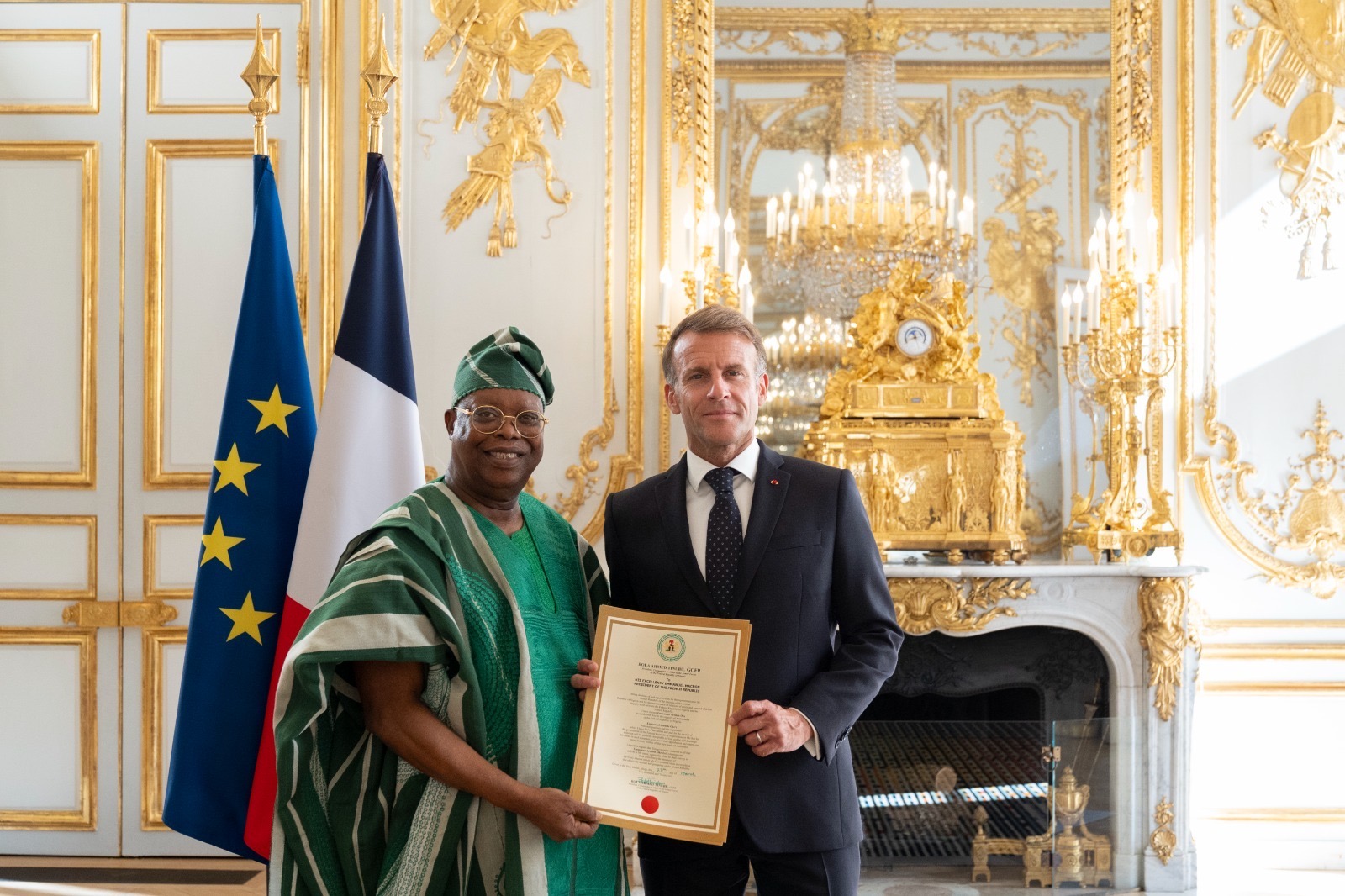
The 17th Ambassador of the Federal Republic of Nigeria to the French Republic, Ambassador Ayodele Oke, CFR has promised to recalibrate the ties between the two countries.
He also promised to give priorities to security, trade, and investment.
Oke unfolded his agenda while presenting his Letters of Credence to the French President, Emmanuel Macron at Élysée Palace in Paris.
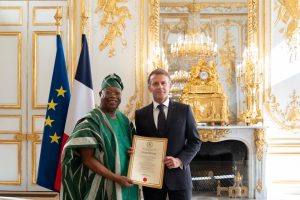
CAPTION: The 17th Ambassador of the Federal Republic of Nigeria to the French Republic, Ambassador Ayodele Oke, CFR presenting his Letters of Credence to President Emmanuel at Élysée Palace on Monday. PHOTO: NIGERIA EMBASSY, PARIS
Envoy’s Priorities for France
A statement by the Nigerian Embassy in Paris said he pledged to uphold Nigeria’s values and reputation with clarity and credibility.
He said: “I am pleased to inform you that on 5 October 2026, I presented my Letters of Credence to President Emmanuel Macron and formally assumed my duties as the 17th Ambassador of the Federal Republic of Nigeria to the French Republic.
“The brief yet significant ceremony took place in the grandeur of the historic, iconic Élysée Palace, with its regal ambience.
“It underscored the compelling need to elevate and recalibrate the partnership between Nigeria and France.
“This means strengthening bilateral relations in security, trade, and investment, while upholding our values and reputation with clarity and credibility.
“It also means shaping conversations, securing advantages, protecting citizens, and promoting Nigeria’s national image.”

From Adeko Ukpa
Rotary International President-Elect, Olayinka Hakeem Babalola, has challenged Rotarians across the world to intensify membership growth and retention efforts, setting an ambitious target of 1.25 million Rotarians and 125,000 Rotaractors globally by 2030.
Babalola issued the charge while outlining his vision for the organisation, urging members to surpass previous achievements and strengthen Rotary’s capacity to create lasting impact in communities.
“As Larry said, we have a goal of 1.25 million Rotarians and 125,000 Rotaractors by 2030. Each new member represents a person who has not yet had their Rotary story. They are out there. And they are waiting for us to welcome them,” he said.
The incoming Rotary International President challenged clubs to exceed their historical performance in membership recruitment and retention.
“So here is my challenge to you: Look back at the last five to seven years in your club. Find your best year for membership growth and retention. Then do better than your best,” he declared.
 CAPTION: L-R: The Incoming Rotary International President, Yinka Hakeem Babalola; the outgoing Rotary International President, Francesco Arezzo; and the Rotary International President Nominee, Larry A. Lunsfor at a Meet-The- President session during the RI Convention Taipei, Taiwan
Babalola described Rotary as a transformative movement that changes lives through service, fellowship and leadership, urging members to share their personal experiences to attract new generations into the organisation.
“Every Rotary member has a story, a moment when fellowship and service stopped being what you did and became who you are,” he said.
“I want us to tell more stories about how Rotary has changed each and every one of us. Because when we do, we show the world that Rotary is more than a service organisation. It is a transformative experience.”
Drawing from his personal journey of more than 40 years in Rotary, Babalola recounted how a literacy project he participated in as a young Rotaractor shaped his lifelong commitment to service.
“My club took on a literacy project when I was a young Rotaractor. We were helping adults in my community learn to read and write. During that project, I watched a woman hold a piece of paper and read her own name for the first time.
“That moment redirected me. I was not simply a young man with opportunities anymore. I was a young man with a responsibility to extend those opportunities to others,” he said.
Babalola unveiled “Create Lasting Impact” as the theme that will guide his presidency, stressing that Rotary must focus on sustainable change rather than short-term achievements.
“In Rotary, we give members a place to belong. We help keep students in school. We organise vaccination campaigns that protect children. These results are real, and they matter deeply. But to create lasting impact asks a harder question: What happens next?” he said.
According to him, Rotary’s future growth must be anchored on meaningful service, peacebuilding and community transformation.
“Peace must be deliberately pursued. It must be built into the design of what we do, not assumed as a by-product,” he stated.
He cited Rotary’s peacebuilding efforts in Colombia as an example of how the organisation is helping communities recover from conflict through leadership development, economic empowerment and reconciliation initiatives.
Babalola also paid tribute to past Rotary leaders, particularly his late friend and mentor, SangKoo Yun, whose philosophy of leadership as “one link in a strong, unbroken chain” he said continues to inspire the organisation.
“Together, we are an unbroken chain, and to grow, we must forge new links in that chain,” he said.
As he prepares to assume office, Babalola called on Rotarians worldwide to seize the opportunity to expand Rotary’s reach and deepen its impact.
“This year is our turn to forge the next link in that chain. Our turn to be changed by Rotary. To build the future we wish to see. To pursue peace deliberately. To Create Lasting Impact — across the globe, in our communities, and in ourselves,” he said.
-
 Opinion2 years ago
Anioma State: A Necessary Proposal Rooted in Strategic Advantage
-
 Opinion6 months ago
Ibileye’s Quiet Revolution at Federal University Lokoja
-

 Business & Economy2 years ago
NASENI, Qietur partner to build 3000 Housing Units for Staff
-
 Business1 year ago
Lithium boom has reshaped Nasarawa’s economy, says Prof Haruna
-
 Law2 years ago
Human Right and Law Enforcement in Nigeria: A Critical Analysis
-
 Education1 year ago
TVET will change Nigeria for good, says NABTEB Registrar
-
Education1 year ago
NABTEB Registrar advises automotive, locomotive Engineers to do more to diversify Nigerian economy
-
 Opinion1 year ago
Engr. Kawu: A Heroic Homecoming for a Man of the People