
News
Ojude Oba and the Silence of a Nation: Dancing While Oyo’s Children Remain in Captivity


By Adinoyi Ukpa
As the horses trotted majestically through the streets of Ijebu-Ode and social media erupted in admiration of flowing agbadas, expensive beads, celebrity appearances and the splendour of the 2026 Ojude Oba Festival, a different Nigeria was unfolding far from the cameras.
In the forests of Oyo State, schoolchildren and teachers abducted by bandits remained in captivity, their families trapped in anguish, uncertainty and fear. While millions of Nigerians debated fashion statements and celebrated cultural pageantry, parents waited anxiously for news of children who had simply gone to school and never returned home.
The contrast was not merely ironic. It was an indictment.
It revealed a nation that appears increasingly comfortable celebrating itself while its children languish in the hands of criminals.
This is not an argument against Ojude Oba. Far from it.
The festival is one of Nigeria’s finest cultural exports. It represents history, identity, community and pride. It is a testament to the enduring strength of Yoruba culture and deserves its place among Africa’s great cultural celebrations.
But culture cannot become an escape from conscience.
What should trouble every Nigerian is not that Ojude Oba was celebrated. What should trouble us is that the kidnapping of schoolchildren no longer possesses the power to interrupt our celebrations.
We have become accustomed to horror. A nation that once recoiled in shock at the abduction of a handful of schoolchildren now treats such incidents as routine news items. We express outrage for a few days, issue statements, offer prayers, blame security agencies, and then move on to the next political controversy, celebrity event or cultural festival.
The children remain behind.
The parents continue to suffer. The kidnappers continue their business.
The country carries on as if nothing has happened.
The Oyo abduction should have triggered a national emergency. Reports from Oriire Local Government Area indicated that armed men attacked schools and communities, abducting pupils, teachers and residents. One teacher reportedly lost his life in captivity. Families have endured days and weeks of agony while awaiting the safe return of their loved ones.
Yet the incident never generated the level of sustained national outrage that similar kidnappings attracted in the past.
Perhaps that is because Nigeria has become desensitised. Perhaps we have seen too many kidnappings. Perhaps we have become too accustomed to headlines about bandits, terrorists and ransom demands. Or perhaps we simply no longer value human life as much as we claim.
The tragedy in Oyo inevitably invites comparisons with earlier school abductions that shook the nation.
In June 2021, armed bandits invaded Federal Government College, Birnin Yauri, in Kebbi State, within the Zuru Emirate. The attack sent shockwaves across Nigeria. Students and teachers were seized and marched into the forests.
The response was immediate and relentless.
The Federal Government mobilised security agencies. Intelligence operations were intensified. Meetings were held at the highest levels of government. Traditional rulers became involved. The issue dominated national discourse for months. Every release of students generated national headlines. Every development was closely monitored.
The process was long and frustrating, but one thing was unmistakable: the country refused to look away.
The victims remained at the centre of national attention until they regained their freedom.
The same pattern was evident in Niger State.
Whether in Kagara, Tegina, Pandogari, Papiri or other communities ravaged by bandit attacks, successive mass abductions provoked urgent responses from both state and federal authorities. Governors convened emergency meetings. Security deployments were increased. Community leaders were engaged. The media maintained pressure. Public attention remained focused on the fate of the victims.
No one could accuse the government of indifference, even where outcomes were delayed.
The nation understood that schoolchildren in captivity represented a direct challenge to the authority of the Nigerian state.
That understanding appears to be fading. Today, the kidnapping of students struggles to compete with entertainment, politics and social media trends. This is dangerous.
Banditry thrives not only because of weak security structures but also because of public fatigue. Criminals understand that outrage has become temporary. They understand that Nigerians have developed a short attention span. They understand that after a few days, another story will dominate the headlines.
This normalisation of insecurity is one of the greatest threats facing the country.
A society that becomes accustomed to kidnapping is a society that has begun surrendering its moral foundations.
The consequences extend beyond the immediate suffering of victims. Parents begin to fear sending children to school. Teachers become reluctant to accept postings to rural communities. Educational outcomes decline. Economic activities suffer. Communities become isolated. Trust in government erodes. Most importantly, citizens begin to lose faith in the state’s ability to perform its most fundamental responsibility: protecting lives.
There is another uncomfortable dimension to this conversation.
Nigeria’s political elite often appears more visible during celebrations than during tragedies.
Photographs from Ojude Oba featured politicians, government officials and influential figures eager to associate themselves with a prestigious cultural event. There is nothing wrong with attending such occasions. Public officials are citizens too. The problem arises when citizens perceive greater enthusiasm for festivals than for confronting national emergencies. Leadership is as much about symbolism as it is about policy.
At moments of national trauma, leaders must demonstrate urgency, empathy and focus. They must ensure that victims know they have not been forgotten. They must convince citizens that government machinery is fully engaged. Anything less creates the impression that public relations has become more important than public safety.
The lesson from Birnin Yauri, Kagara, Tegina and numerous other school abductions is clear: sustained public attention matters.
Governments respond more aggressively when citizens refuse to look away. Security agencies perform better when subjected to scrutiny.
Political leaders become more accountable when public pressure remains constant.
That is why Nigerians must resist the temptation to normalise the Oyo tragedy.
The kidnapped children and teachers deserve more than fleeting sympathy. They deserve national attention.
They deserve sustained advocacy. They deserve a government that treats their captivity as a matter of utmost urgency. And their families deserve to know that the country has not abandoned them.
Ojude Oba will come again next year. The horses will return. The colourful attire will return. The music, festivities and celebrations will return.
But for the parents waiting for news from Oyo State, every passing day feels like a lifetime.
Long after the photographs from Ijebu-Ode disappear from social media timelines, those families will still remember the nights spent praying for the safe return of their children.
That is why the real question confronting Nigeria is not whether Ojude Oba should be celebrated. It should.
The real question is why a nation facing an epidemic of school kidnappings appears increasingly capable of celebrating everything except the urgency of rescuing its children.
Until we answer that question honestly, every grand festival will carry an uncomfortable shadow. Because somewhere beyond the music, beyond the glamour, beyond the pageantry and prestige, frightened children are still waiting to come home.
And no nation should be comfortable dancing while that remains true.
***Ukpa a public affairs analyst writes from Okene, Kogi State.
Stop Starting. Start Finishing: Why Continuity Is Strategically Important for Nigeria in 2027
by Mary Laniyan
“Stop starting. Start finishing,” is a popular agile transformation principle used to shift organisations away from measuring activity and toward delivering value and measurable outcomes. Governments are not corporations, but the underlying economic principle is comparable. In government, the stakes are infinitely higher, they have a human cost.
The cost is measured in the lives of ordinary people, the pain of making ends meet, the anxiety of raising a family, the frustration of being unable to find meaningful work, the loss of dignity that comes from being unable to be productive and self-reliant, and, above all, the uncertainty surrounding the future of an entire generation of young Nigerians. That is why I dare say this: Nigeria does not need another beginning in 2027. Nigeria needs continuity, discipline and the courage to finish what it has started.
The problem with perpetual beginnings.
By the time the presidential baton changed hands in 2023, the Nigerian foundation had deteriorated significantly. Consequently, regardless of who assumed office, there was always going to be a period of pain, if the genuine intention was to confront the structural problems that had bedevilled the country for decades.
Structural reforms are rarely painless.
Much like a house with serious structural defects, a fresh coat of paint may make the building look beautiful in the short term, but it does not fix the structural issues at the core of its foundation. Eventually, the underlying problems return, and often with greater consequences. Nigeria cannot afford to keep painting over structural cracks. Fixing the foundation requires something that our political system has historically struggled with, and that is continuity.
The tyranny of the “pet project.”
As we look towards 2027, I believe it is not too early to appeal to the conscience of our political elites to embrace a mindset of “continuity for impact” and move away from the political “pet project” mindset.
Every administration naturally wants to leave its own mark. There is nothing inherently wrong with that, but if we put Nigeria first and put on the hat of a relay race athlete, you win and Nigeria wins. Leaving your mark should not be more important than building on what already exists for a much needed outcome. A new administration arrives. A new set of priorities are announced. Existing programmes are renamed, abandoned, redesigned or simply starved of political attention. Years later, another administration arrives and starts the cycle all over again. The result is predictable, we become very good at starting and very poor at finishing and Nigeria pays the price.
Ajaokuta should never become normal.
I belong to a generation that still mourns the story of the Ajaokuta Steel Complex. Ajaokuta represents one of Nigeria’s most consequential industrial missed opportunities, not merely because a steel plant was never fully realised, but because of the industrial ecosystem that could have developed around it. A functioning integrated steel industry could have supported engineering, manufacturing, construction, machinery, transportation, mining and a range of downstream industries. It could have created skills, supply chains and industrial capabilities that would have outlived any single administration. That is the tragedy of Ajaokuta.
We did not merely fail to finish a project; we potentially failed to finish an industrialisation strategy that would have revolutionized Nigeria for a generation yet unborn.
And then there is Mambilla.
The Mambilla Hydroelectric Project represents another extraordinary missed opportunity. Nigeria has spent decades confronting one of the fundamental constraints on economic development, inadequate and unreliable electricity. We have repeatedly struggled to complete major projects capable of expanding the country’s power-generation capacity at scale.
Mambilla is a powerful reminder that infrastructure of national significance cannot be treated as the property of whichever administration happens to inherit it. If projects such as Ajaokuta and Mambilla had been successfully completed, integrated into the wider economy and properly maintained, I believe Nigeria’s economic trajectory could have been profoundly different. One finished project may not magically transform a nation, but it will create platforms upon which other opportunities can be built.
Continuity is not political loyalty, this is an important distinction. Continuity should not mean defending everything a previous administration did. It should not mean refusing to correct mistakes. It should not mean protecting failed policies because of political allegiance. Continuity means identifying what is strategically important to Nigeria, preserving what works, correcting what does not, and finishing what deserves to be finished.
A new administration should have the courage to say: This may not have been my project, but it is imperative that we finish it. That is the mindset we need. Imagine a Nigeria where successive administrations measured themselves not only by what they started, but by how many strategically important national projects they successfully completed. It is in this context that Hon. Minister Nyesom Wike comes to mind. He should be applauded for finishing a lot of projects that he didn’t start.
How do we make this work?
Every administration should have the opportunity to shine within a 20 to 30 year national development horizon, while plugging into a clearly defined Nigerian National Development Strategy that provides a consistent North Star.
The long-term strategy should set out where Nigeria wants to be in 20 or 30 years. Each administration should then be responsible for defining the specific priorities, reforms and measurable outcomes it will deliver during its tenure to move the country closer to that destination. The destination remains consistent; administrations compete on how effectively they move the country forward. This creates the right balance between continuity and accountability.
Let’s get Organised
“We are not outnumbered, we are out-organised.” The quote is widely attributed to human rights activist Malcolm X, I believe it resonates deeply with our context today. Nigeria is not short of people, ideas, talent, ambition or resources. We need government to create the conditions in which Nigerians can do more for themselves. Nigerians in my opinion, are the easiest to govern because of their resilience and grit. That is why 2027 should not simply be another political contest. It should be an opportunity to ask a more fundamental question: What must Nigeria continue, complete and institutionalise to leverage its people for a vibrant economy.
And if we genuinely want to change the trajectory of this country, perhaps the most important political and civic discipline we can embrace is also the simplest.
Stop starting.
Start finishing.
Mary Laniyan
Systems Performance Coach
From Adeko Ukpa
Senator representing Bauchi South, Shehu Buba, has dismissed as fabricated allegations and viral videos linking him to alleged bandit kingpins.
He said the materials being circulated online were deliberately manipulated to damage his reputation.
Buba, who is the Chairman of the Senate Committee on Livestock and Animal Husbandry and the Peoples Redemption Party (PRP) governorship candidate in Bauchi State, said a fact-check had established that the viral videos combined two unrelated clips.
He said the individuals in the first video spoke Fulfulde, while those in the second spoke English, insisting that the claim that the footage showed bandits visiting his residence was false.
In a statement titled “Setting the Record Straight: My response to fabricated videos, false allegations and a sustained campaign of disinformation,” Buba said the first clip showed Kaduna-based Hajj returnees who visited his residence in 2023, while the second showed different individuals displaying passports.
Senator Buba rejected the allegations, describing them as false, malicious and part of a coordinated campaign driven by financial motives and partisan interests rather than any genuine concern for truth or accountability.
He challenged individuals and organisations with credible evidence of wrongdoing to submit it to the appropriate authorities.
He insisted that he has nothing to hide and nothing to fear from any legitimate investigation.
He also urged his supporters not to be provoked, stressing that their focus must remain on winning the 2027 elections and offering Bauchi State a credible alternative built on service, development and security.
“Let us remain calm, disciplined and committed to the democratic process,” he said.
The senator said he initially refrained from responding to the allegations because of the sensitive nature of his previous responsibilities as Chairman of the Senate Committee on National Security and Intelligence.
According to him, national security requires discretion because publicising certain operational successes could expose sources, endanger individuals and communities, or compromise ongoing interventions.
He said: “For much of my public life, I have resisted the temptation to respond to every allegation, criticism or provocation directed at me.
“Citizens have a legitimate right to scrutinise those entrusted with public responsibility, and public officials must be prepared to account for their conduct.
“My election as Senator representing Bauchi South Senatorial District – and particularly my
responsibility as Chairman of the Senate Committee on National Security and Intelligence – reinforced the need for restraint. National security demands discretion.
“Operational successes cannot always be publicised without jeopardising ongoing efforts, exposing
sources or endangering individuals and communities involved in sensitive interventions.
“It was in that spirit that I initially declined to respond to the recent circulation of videos purporting to show “high-profile bandit kingpins” visiting my residence.
“However, the persistent recycling of these materials, accompanied by increasingly serious allegations, makes it necessary to place the facts before Nigerians.”
According to him, “This campaign dates back to September 15, 2024, when Umar Shayi led a militia group purported to be hunters working for the Bauchi State Agency for Vigilante and Youth Empowerment.
“The group reportedly killed two charcoal sellers who were conducting their
lawful business. As the elected Senator representing the district, I visited the families of the
deceased to condole with them and called on the relevant authorities to ensure justice is served.
“I also vowed to pursue lawful action on behalf of both the deceased and the injured
victims.
“I condemned the killings and urged the government to institute safeguards against
abuses by those entrusted with protecting citizens.
“Following my intervention, the Bauchi State Commissioner for Internal Security and Home Affairs, Barrister Abubakar Abdulhamid Bununu, publicly linked my name to banditry —an allegation I rejected as false and unsupported by evidence.
“Subsequently, Governor Bala Mohammed petitioned President Bola Ahmed Tinubu that I sponsored a ‘bandit kingpin’ to perform the 2024 Hajj through an aide named Yahaya Ibrahim.
“I categorically denied these allegations. I stated that I had no aide by the name cited and invited security agencies to investigate.
“My sponsorship of pilgrims – like my scholarships,
medical interventions and other empowerment programmes – has always been based on
recommendations from community and religious leaders.
“These philanthropic initiatives predate current political disagreements and have benefited people from diverse backgrounds. Community and religious leaders make the recommendations, and I do not personally screen or select beneficiaries.
“These efforts are also anchored in my principled
commitment to constructive engagement, conflict resolution and non-kinetic approaches to
addressing Nigeria’s numerous challenges – principles that have shaped my current doctoral
research at the University of Jos, where I am a PhD candidate.
“Rather than engage in a war of words, I sought legal redress by filing a defamation suit, CV/413/2024, before the High Court of the FCT.”
The senator also addressed the case of Hassan Husseini, whom he said was introduced to him in 2024 as an orphan requiring educational assistance.
He said: “ It is important to explain the origin of some of the photographs and videos now being circulated.
“In 2024, a young man named Hassan Husseini was introduced to me as an orphan needing
educational assistance. Supporting vulnerable young people has long been part of my community interventions.
“I enrolled him in a private college in Kaduna and an Islamic school, and provided him with a bicycle for transportation.
“After some time, Hassan abandoned his education and approached me for a substantial sum
to start a car dealership.
“I declined and advised him to return to school. I later discovered that, while under my care, he had recorded photographs and videos of
visitors to my residence. These materials later formed the basis of allegations circulated on social media.
“After the videos circulated and those sharing the videos and photos demanded money as extortion, I petitioned the Nigeria Police Force on September 9, 2025. Several individuals were arrested and investigated.
“On October 30, 2025, five suspects were arraigned before Justice Rita Ofili-Ajumogobia of the Federal High Court, Abuja, in Charge No. FHC/ABJ/CR/526/2025, on charges including
criminal conspiracy, cyberstalking, criminal defamation, advance-fee fraud and extortion.
“The matter is before a competent court, and I will refrain from comments that could prejudice the proceedings. The next hearing is scheduled for September 29, 2026.”
Buba said he had also taken legal action following remarks by former Bauchi State Governor and APC governorship candidate Mohammed Abdullahi Abubakar, SAN, in July 2026 concerning the source of his wealth.
He said political disagreements should be settled through debates on policies, competence and vision rather than character assassination, adding that his decision to leave the APC for the PRP should not be used as a basis for fabricated allegations.
He said: “In July 2026, former Bauchi State Governor and APC gubernatorial candidate Mohammed Abdullahi Abubakar, SAN, publicly questioned the source of my wealth and made remarks I
considered defamatory.
“Again, I chose lawful action over political confrontation and instructed my lawyers, Jay Adl Attorneys, to petition the appropriate authorities.
Political disagreement should never justify character assassination.
“My decision to leave the
APC for the Peoples Redemption Party (PRP), under whose platform I am pursuing my gubernatorial aspiration, should be debated on policies, competence and vision – not on fabricated allegations.”
On his record in national security, Buba said he had advocated a comprehensive approach combining military operations with community engagement, dialogue, intelligence gathering, deradicalisation and confidence-building.
He said Nigeria could not defeat insecurity through military force alone, stressing the need to win the trust of vulnerable communities and strengthen local intelligence networks.
He said: “For two years, I served as Chairman of the Senate Committee on National Security and
Intelligence, a role that placed me at the intersection of legislative oversight, intelligence,
security policy and engagement with communities affected by insecurity.
“Throughout that period, I supported a comprehensive approach to security. While kinetic operations are necessary, I consistently advocated complementary non-kinetic strategies
involving community engagement, dialogue, intelligence gathering, deradicalisation and
confidence-building.
“Nigeria cannot defeat insecurity by military force alone. Sustainable security requires winning the trust of vulnerable communities, strengthening local intelligence networks and
creating pathways for cooperation with legitimate authorities.
“Some of these interventions cannot responsibly be discussed in detail. Revealing identities of intermediaries or operational information could endanger patriotic citizens and undermine ongoing efforts. My silence on such matters should never be interpreted as an absence of service.”
He said his public service also included scholarships, educational sponsorship, medical assistance, youth empowerment and support for vulnerable families across Bauchi South and beyond.
He said: “My commitment to public service predates my political career. I have invested in scholarships, educational sponsorships, medical assistance, youth empowerment and
support for vulnerable families across Bauchi South and beyond.
“Philanthropy is not a political slogan for me – it is an obligation. Not every intervention attracts publicity, nor should it. Public service should be measured by lives touched, opportunities created and communities strengthened.
“It is deeply unfortunate when acts of compassion or legitimate security-related contacts are stripped of context and repackaged as evidence of wrongdoing.
“I welcome scrutiny, but scrutiny must be fair.
I do not claim immunity from scrutiny. As a Senator, a former Chairman of the Senate Committee on National Security and Intelligence, currently chairing the Senate Committee on Livestock and Animal Husbandry, and now a gubernatorial candidate, I recognise that my
actions and associations will be examined.
“That is democracy. But scrutiny must be based on
facts. There is a difference between investigation and fabrication, between criticism and blackmail, and between political opposition and deliberate character assassination.
“Modern disinformation thrives on recycling old allegations, editing them, attaching new
captions and redistributing them until repetition masquerades as evidence.
Responsible citizens and journalists must resist this.”
Buba appealed to journalists, editors, fact-checkers, civil society organisations and opinion leaders to subject the allegations to professional scrutiny by verifying the videos, establishing the identities of those involved, reviewing court records and consulting relevant security institutions.
“I appeal to editors, journalists, fact-checkers, civil society organisations and opinion leaders to approach these allegations with professionalism and fairness.
“Verify the videos. Examine their origins. Establish the identities of the individuals involved. Review court records. Consult relevant security institutions. Subject my explanations to
scrutiny as well.
“I will continue to defend my name through lawful means. More importantly, I will continue the work that has defined my public life: serving my constituents, supporting those in need and contributing to the peace and security of our nation.
The facts should speak louder than propaganda,” he said.
By Adeko Ukpa
The Rotary Club of Abuja Legacy has declared its intention to make purposeful and measurable impact in community development, launching its activities with a maternal and child health outreach in Abuja.
Although yet to make its formal public debut, the club said it had already defined its mission and priorities, choosing to begin with an intervention aimed at improving maternal healthcare.
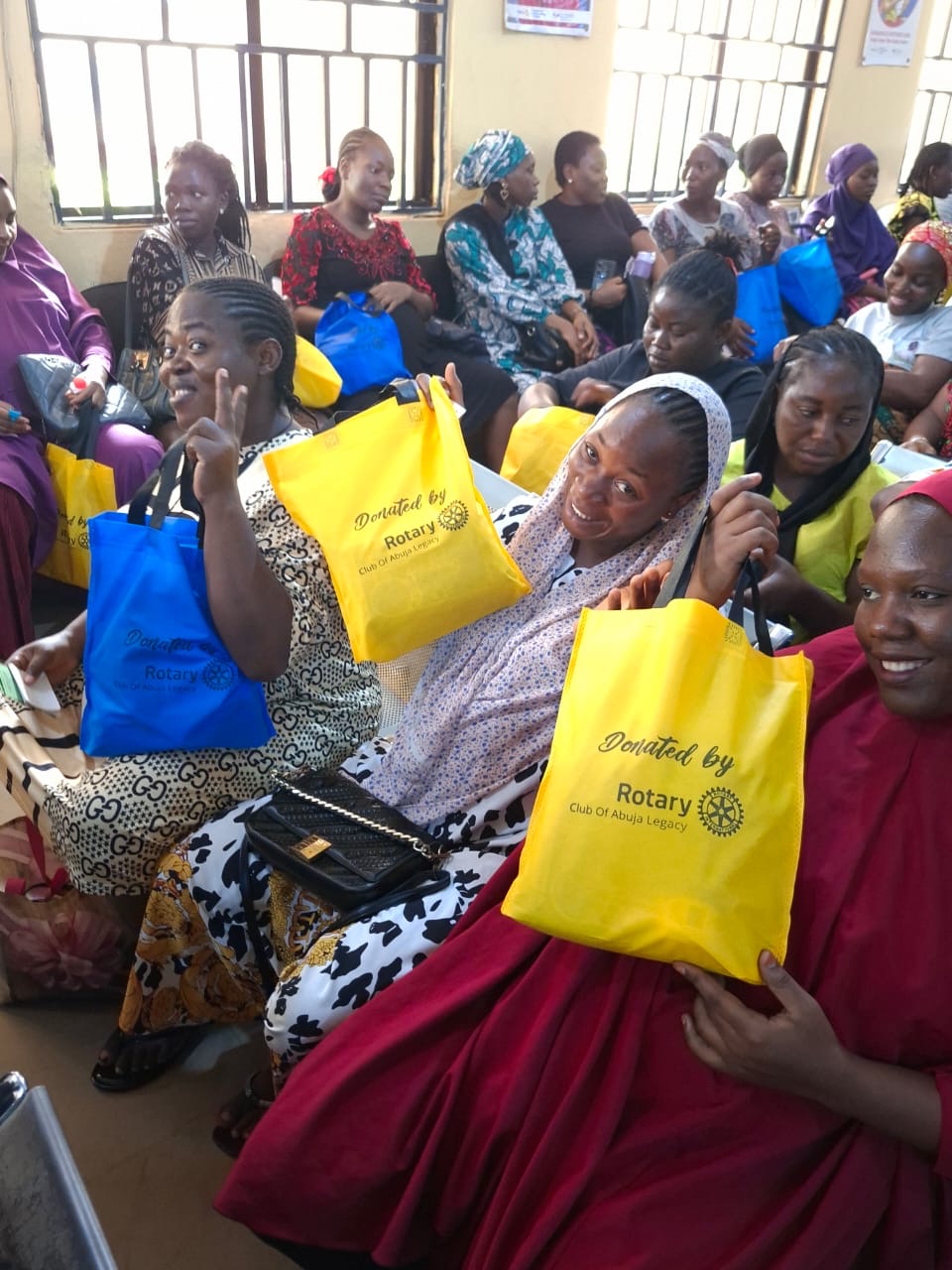
The initiative, conducted at Gwarimpa General Hospital, Lifecamp, reached over 100 expectant mothers with free birthing kits and health education sessions focused on postpartum depression and emotional wellbeing after childbirth.
According to the club, the programme underscores the need for maternal care to extend beyond delivery by addressing the mental health needs of new mothers.
Charter President, Winifred Mngu Mbashall, said the club was founded on the principle of intentional service rather than symbolic activities.
“We didn’t come to find our voice; we built it before we arrived. If we care about how babies are born, we must care about how mothers heal, and that is the legacy the Rotary Club of Abuja Legacy is here to leave behind,” she said.
Also speaking, Project Chair, Annmarie Ada Adamu, said the club intends to distinguish itself through impactful programmes that combine Rotary’s humanitarian tradition with innovative approaches to community service.
“We are not here to blend in with tradition; we are here to elevate it. This is Rotary, redefined through intentional impact,” she said.
Beneficiaries during the outreach.
The Rotary Club of Abuja Legacy said the maternal and child health project is the first of several planned interventions as it seeks to establish itself as a leading platform for sustainable humanitarian service and community development.
-
 Opinion2 years ago
Anioma State: A Necessary Proposal Rooted in Strategic Advantage
-
 Opinion4 months ago
Ibileye’s Quiet Revolution at Federal University Lokoja
-
 Business & Economy2 years ago
NASENI, Qietur partner to build 3000 Housing Units for Staff
-
 Law2 years ago
Human Right and Law Enforcement in Nigeria: A Critical Analysis
-
 Business11 months ago
Lithium boom has reshaped Nasarawa’s economy, says Prof Haruna
-
 Education1 year ago
TVET will change Nigeria for good, says NABTEB Registrar
-
Education1 year ago
NABTEB Registrar advises automotive, locomotive Engineers to do more to diversify Nigerian economy
-
 Opinion1 year ago
Engr. Kawu: A Heroic Homecoming for a Man of the People