
Arts & Life
Rotary Club earmarks N20m for Maternal Health, Boy-Child Education


By Adeko Ukpa
The 13th President of the Rotary Club of Abuja Maitama, Rtn. Rosemond Favour Uche, has said her club will spend N20million on masses-oriented projects.
Rotarian Uche disclosed this in her speech during her investiture as the 13th President of the Rotary Club of Abuja Maitama.
She listed the priority projects of the club for the new Rotary Year to include maternal and child health in rural areas of the Federal Capital Territory (FCT), improvement in water supply in the Kuje Correctional Facility, and focus on the development of the boy-child.
She pledged to expand the Club’s impactful work both locally and globally.
“In our 2024-25 plans, this club will undertake projects in Rotary’s seven core thematic areas, estimated at N20m.
“Our projects have been a testament to Rotary’s enduring commitment to humanitarian service and have made a significant impact on countless lives”.
She also said the club will promote peace, fight disease, provide clean water, sanitation, and hygiene, save mothers and children, support education, grow local economies, and protect the environment, adding that her focus will particularly target her three key areas she’s passionate about..
She said: “As we are taking off, July is known as the month of maternal health and child care, so, first of all, we will locate hospitals in the interior of the FCT. We want to prioritize village hospitals for maximum impact.
“We will give them birthing bags that contain all the compulsory items required for pregnant women before they deliver in a hospital. We are going to start with 100 bags and distribute them to village hospitals in rural communities.”
“Another significant project is improving the Kuje Correctional Facility’s water supply. Having discovered that their borehole is outdated and filled with mud, we will either dig a new one to be solar-powered, ensuring they can pump water even without the main power supply.
“The place is a correctional center, no longer a place to inflict punishment, so we need to make the environment conducive for them.”
Uche also highlighted the importance of focusing on the boy-child, saying, “The plight of the boy-child tops my priority list. While we often discuss the girl-child, I discovered that if these impressionable boys are not well-mentored at a prime age, they end up destroying the women you have nurtured.
“We need to spotlight the need for early and adequate attention and nurturing of the boy-child. We all know that if you train a girl or a woman, you have trained a nation. But to prevent untrained boys from derailing or destroying the trained girls, we must also focus on the future of the boy-child.
“This is what we want to champion through training, mentoring, equipping, and empowering them for future challenges.”
In her valedictory speech, the immediate past President of the club, Joyce Agwu, reflected on the successes of her tenure, expressing gratitude for the team’s unwavering dedication.
She revealed that 29 service projects were completed, transforming countless lives and leaving a profound legacy of service and empathy.
Agwu expressed confidence in Uche’s ability to elevate the Club’s work.
“As we gaze ahead towards the promising horizon that the upcoming year unveils, let us carry forth the invaluable lessons imbibed and the triumphs attained.
“The dawn of the new year brings fresh prospects for us to innovate, collaborate, and perpetuate our ethos of service above self,” she said.
The Chairman of the occasion, Chris Uche, a Senior Advocate of Nigeria (SAN), urged Nigerians to emulate Rotary’s leadership succession method, which is devoid of rancor or litigation while also encouraging political leaders to work selflessly for the people they serve.
The event concluded with awards of honor to philanthropists and individuals who have distinguished themselves in humanitarian service.











…Newborn deaths fall by 45% in supported health facilities
From Adeko Ukpa
Rotary International President, Olayinka Hakeem Babalola, has disclosed that maternal deaths in health facilities supported by the organisation’s maternal healthcare intervention in Nigeria have declined by 77 per cent, while newborn deaths dropped by 45 per cent.
He attributed the improvement to sustained collaboration between Rotary, government health authorities, community health workers and international partners under the organisation’s Together for Healthy Families in Nigeria programme.
Babalola made the disclosure while delivering his keynote address at the All Nigeria Rotary Peace Summit held in Lagos, where he highlighted the organisation’s contributions to healthcare delivery, community development and peacebuilding.
He said the programme, launched in 2022, was designed to improve maternal and child healthcare by strengthening prenatal services and expanding access to essential medical supplies and equipment.
According to him, Rotary members in Nigeria, working with partners in Germany and federal and state health ministries, had supported expectant mothers across three states and the Federal Capital Territory.
He disclosed that community health workers had conducted nearly 60,000 home visits to expectant mothers and their families, while 158 healthcare facilities received contraceptives, medicines and medical equipment.
Babalola said: “We have already seen positive outcomes. Maternal deaths were reduced by 77%, and newborn deaths were reduced by 45% at supported facilities.”
He described the achievements as evidence that improving access to essential social services could contribute significantly to national stability and peace.
According to him, providing families with access to safe maternal healthcare reduces preventable deaths, strengthens community confidence and eases pressure on government health institutions.
“With each child born safely to a healthy mother, we ease the burden carried by the Federal Ministry of Health and Social Welfare. We give families a greater sense of safety and security,” he said.
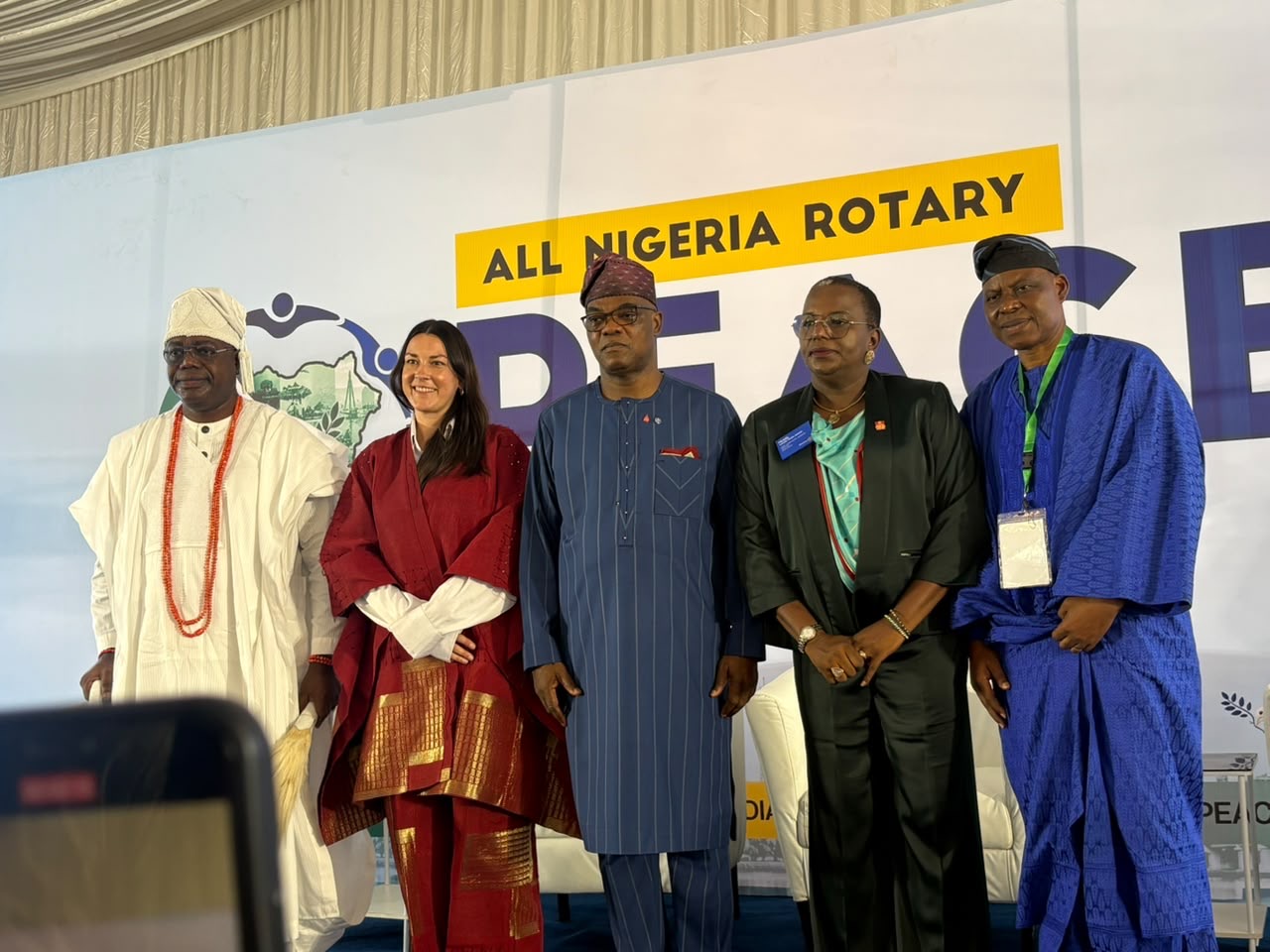
CAPTION: L-R: The Alara of Ilara, Oba Olufolarin Olukayode Ogunsanwo; the Director of Partnerships, Institute for Economics and Peace, Lea Prekerests; RI President Olayinka Babalola; The Rotary Foundation Trustee, Ijeoma Pearl Okoro; and the Chair of central Planning Committee of All Nigeria Peace Summit, Dr. Kazeem Mustapha at the opening of the summit in Lagos on Saturday. PHOTO: ROTARY INTERNATIONAL
The Rotary International President explained that the organisation’s understanding of peace extended beyond the absence of armed conflict to include access to healthcare, education, justice, opportunities and other conditions necessary for human development.
He described such interventions as part of Rotary’s Positive Peace philosophy, which focuses on addressing the underlying conditions that sustain peaceful and stable societies.
Babalola said: “To grow Positive Peace from the ground up, Rotary starts from the very foundation of life, as we have done here.”
He also highlighted Nigeria’s success in eliminating indigenous wild poliovirus transmission, noting that the country had remained free of the deadly virus since 2020.
He said Rotary continued to work with the World Health Organisation and other partners to sustain the achievement and respond to outbreaks of variant poliovirus.
Babalola further disclosed that Rotary had partnered with Makerere University in Uganda to establish a Peace Centre in 2021, following Nigeria’s declaration as wild polio-free.
The centre provides training for Peace Fellows on conflict prevention, peacebuilding and the development of sustainable approaches to resolving disputes across Africa.
He said more than 75 Rotary Peace Fellows had come from Nigeria over the years, with some participating in the summit.
The Rotary chief maintained that the organisation’s commitment to peacebuilding was demonstrated not only through advocacy but also through practical interventions that improve people’s lives.
“I tell you this not to advertise Rotary. I tell you this because I want you to know that Rotary is already a quiet partner in peacebuilding — not only around the world — but here in our shared home,” he said.
He added that Rotary members were committed to bringing people together through service and collective action.
“As members of Rotary, we are not soldiers, ambassadors, or diplomats. We bring people together to find common purpose through service to others. We are here for Nigeria, and we are here to stay,” he said.
Babalola urged government institutions, development partners, community leaders and citizens to strengthen collaboration in addressing challenges affecting ordinary Nigerians.
He stressed that sustainable development required people and institutions willing to change and work towards a common national future.
He said the ultimate objective should be a Nigeria where every citizen, irrespective of background, enjoyed access to justice, opportunity and dignity.
The Rotary International President called on members of the organisation to make peacebuilding a lasting legacy.
He stressed that the benefits of their interventions should extend to generations yet unborn.
In her paper, the Director of Partnerships, Institute for Economics and Peace, Lea Prekerests noted that there are two kinds of peace, adding that peace is more than the absence of violence.
According to Prekerests, while Negative Peace is the absence of violence or the fear of violence, Positive Peace represents the attitudes, institutions and structures that create and sustain peaceful societies but Positive Peace is what makes peace last.
The Inspector General of Police, Olatunji Disu, in his paper, called for collaboration between the Rotary International and the police
to strengthen the partnerships that connect institutions with communities, government with citizens, and security with service.
The IGP, who was represented by AIG Miller Dantawaye, said: “Let us translate that principle into action. Let us work together to build communities where justice is accessible, institutions are trusted, citizens are responsible and every individual can live with dignity, security and hope. That is the foundation of lasting peace.
“Let me therefore take the first bold step of appealing to the RI president that we jointly fix a date for the first official Police/Rotary fellowship that will be jointly presided by the IGP and RI President to kickstart the collaboration.”
By Adeko Ukpa
The Rotary Club of Abuja Legacy has declared its intention to make purposeful and measurable impact in community development, launching its activities with a maternal and child health outreach in Abuja.
Although yet to make its formal public debut, the club said it had already defined its mission and priorities, choosing to begin with an intervention aimed at improving maternal healthcare.
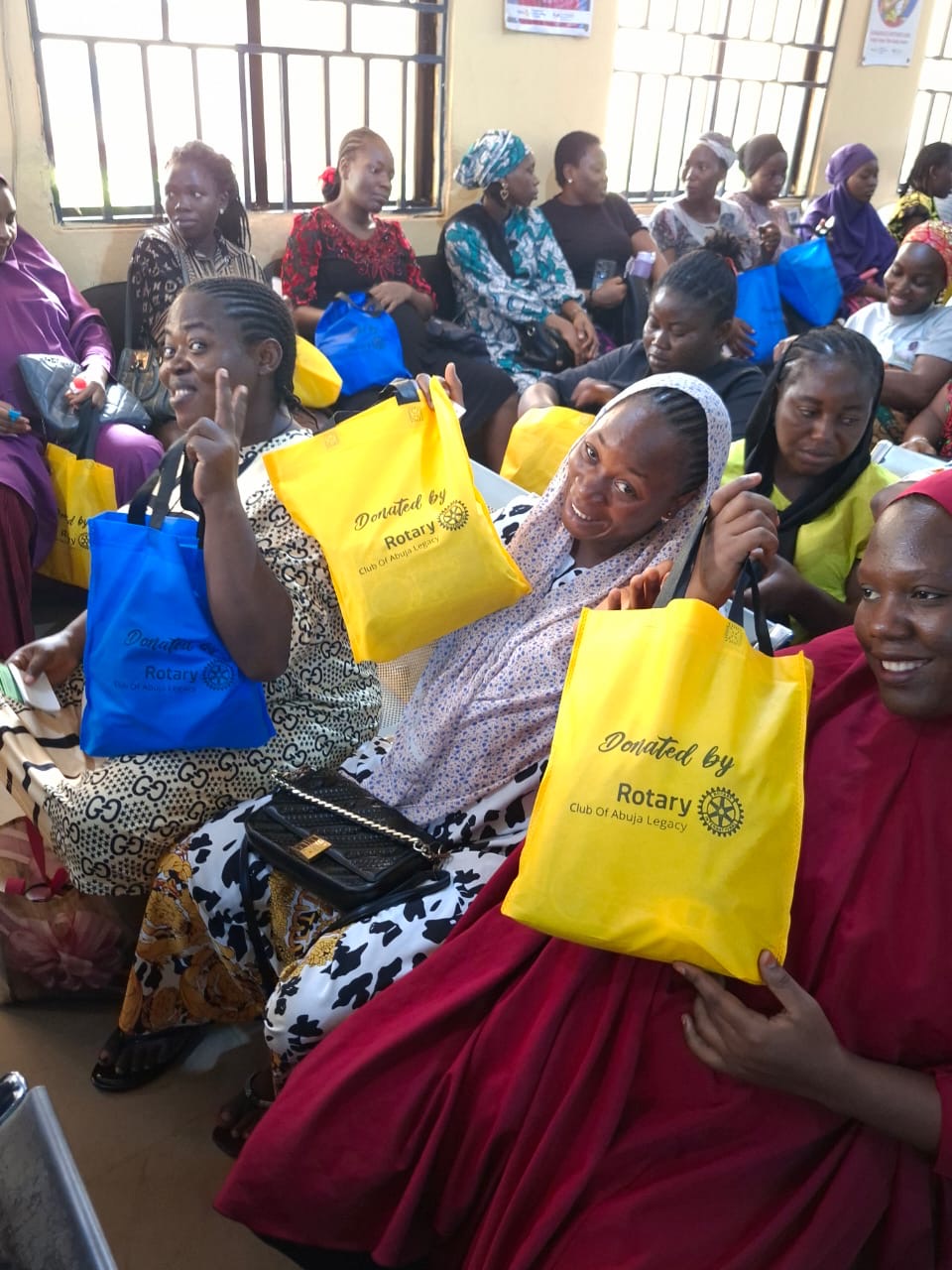
The initiative, conducted at Gwarimpa General Hospital, Lifecamp, reached over 100 expectant mothers with free birthing kits and health education sessions focused on postpartum depression and emotional wellbeing after childbirth.
According to the club, the programme underscores the need for maternal care to extend beyond delivery by addressing the mental health needs of new mothers.
Charter President, Winifred Mngu Mbashall, said the club was founded on the principle of intentional service rather than symbolic activities.
“We didn’t come to find our voice; we built it before we arrived. If we care about how babies are born, we must care about how mothers heal, and that is the legacy the Rotary Club of Abuja Legacy is here to leave behind,” she said.
Also speaking, Project Chair, Annmarie Ada Adamu, said the club intends to distinguish itself through impactful programmes that combine Rotary’s humanitarian tradition with innovative approaches to community service.
“We are not here to blend in with tradition; we are here to elevate it. This is Rotary, redefined through intentional impact,” she said.
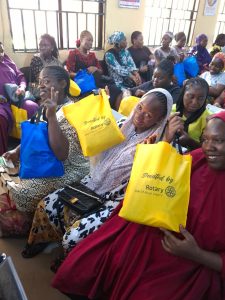
Beneficiaries during the outreach.
The Rotary Club of Abuja Legacy said the maternal and child health project is the first of several planned interventions as it seeks to establish itself as a leading platform for sustainable humanitarian service and community development.
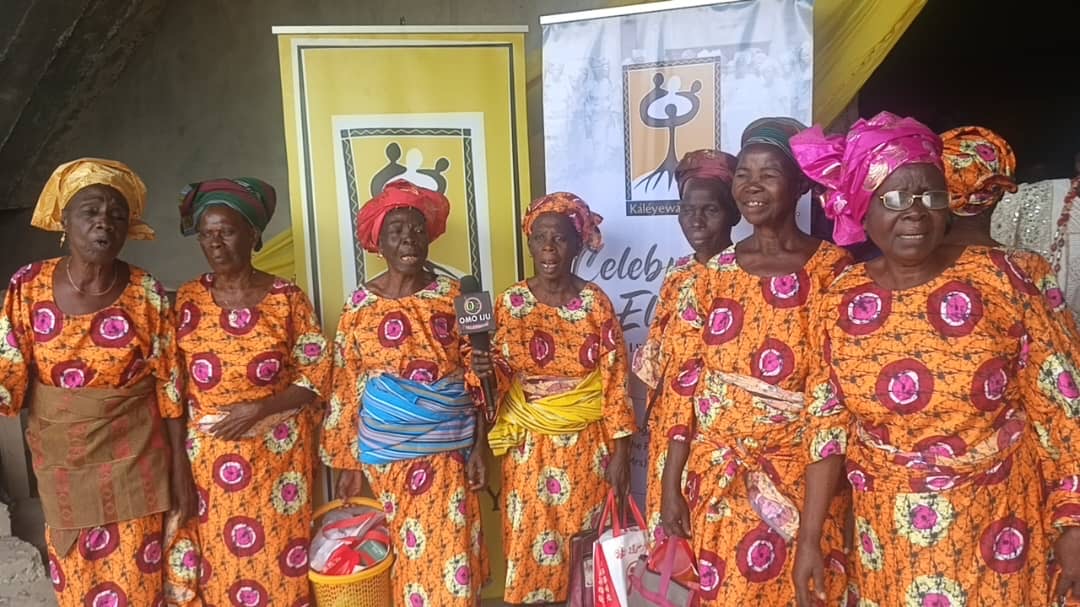
Twenty-four years after Dr. Olukemi Adamolekun was brutally killed, the vision she conceived for the care of elderly Nigerians continues to touch hundreds of lives through Kaleyewa House.
Some people leave behind memories; others leave behind a mission. Dr. Olukemi Adamolekun left both.
While living in the United States with her husband, Ladipo Adamolekun, in the period leading up to his retirement from the World Bank, Olukemi began thinking about what she could do for elderly people in her hometown, Iju, Ondo State.
She had seen the group-home system in the United States and began considering how such a model could be adapted to Nigeria. Her vision was to establish a place where elderly people could receive food, medical care and, for those who needed it, accommodation.
It was a simple idea, but a profound one: to create a system in which elderly people would not be forgotten or left to fend for themselves.
The vision attracted the attention of the Ondo State Government under the administration of the late Governor Adebayo Adefarati. The government welcomed the proposal and Dr. Akerele Adu, who was then a commissioner in the administration, was directed to facilitate the allocation of land for the proposed group home.
Land was subsequently allocated along Igbatoro Road.
But Olukemi would never live to see the dream become the institution she had imagined.
She registered the initiative as a non-profit organization with the Corporate Affairs Commission in 2001. On May 4, 2002, barely a year later, while in Nigeria pursuing the Kaleyewa project, she was shot at the Efunsetan Roundabout in the heart of Ibadan, Oyo State.
She was approaching her 56th birthday.
The circumstances surrounding her death remain painful for her family. She was chauffeur-driven at the time. According to the account of the family, the hoodlums locked the young driver in the trunk of the vehicle and later abandoned him at the Seme border. Twenty-four years later, the family says there has been no arrest and no recovery of the vehicle.
It was a devastating end to the life of a woman who had returned to Nigeria with the intention of improving the lives of elderly people.
Her death could easily have marked the end of Kaleyewa House.
It did not.
At the first anniversary of her death in 2003, her husband, children and others involved in the project resolved to continue the work she had started. A board was constituted for Kaleyewa House, and the family has remained committed to the project ever since.
The original vision, however, suffered a major setback. The land allocated by the Adefarati administration was subsequently revoked under the administration of former Governor Olusegun Mimiko.
The revocation meant that the group home Olukemi had envisaged could not proceed as originally planned. In response, her children decided to rebuild the house of her late mother as a future home for Kaleyewa House.
For now, Kaleyewa continues its work from a smaller base than the founder had envisioned.
But the size of the building has not diminished the size of the impact.
Kaleyewa House currently has more than 400 elderly people under its care. Food, medical tests and treatment are provided to beneficiaries on a bi-monthly basis. Its reach extends beyond those who are physically able to attend activities organized by the organization. Elderly people who are bedridden and unable to attend are also attended to.
For some beneficiaries, Kaleyewa House also pays rent, providing assistance to people whose circumstances make accommodation a challenge.
In many ways, Kaleyewa has become a lifeline to elderly people in Iju and it’s immediate neighboring community Itaogbolu.
At the recent celebration of what would have been Dr. Adamolekun’s 80th birthday, the impact of her vision was visible.
In Iju, elderly beneficiaries gathered in their Aso-Ebi to celebrate the woman whose dream had brought them together. They were treated to food, entertainment and gifts to take home. Beyond the material benefits, however, there was something else on display: companionship.
For many of the elderly people present, being surrounded by people of their own generation appeared to bring genuine joy. The occasion offered them an opportunity to eat together, laugh together and simply enjoy one another’s company.
It was, in its own way, a celebration of a life that had been cut short but a vision that had survived.
A childhood friend of Olukemi who referred to her as a ‘Rose behind the walls’ at her demise, Mrs. Omotewa Aderibigbe said her friend tried in vain to make her fall in love with Mathematics, a subject she never understood how anyone could be comfortable with.
Her words”
Kemi was my childhood friend. We attended the same Pry School, and the same Secondary School (Fiwasaye Girls’ Grammar School, Akure). Growing up together in the village, was fun, but under very strict discipline. Being together was our cherished bond. We used to go to the stream in the bush to wash our clothes in preparation for school resumption. We would then enter the stream, and bathed with our dresses on. It was all giggles. I used to pity her when she was sent home for school fees along with some of us, because, I saw her traumatized in the midst of affluence”.
Aderibigbe who retired as a Deputy Director from the Ministry of External Affairs who herself turned 80 in April said Olukemi never allowed any setback to dampen her resolve to excel in life.
“She was good in Mathematics and I was good in English. I hated Mathematics with a passion. She would try to help me with Mathematics and I would refuse. She would tell me Mathematics was as simple as English: (the same words our School Principal used, to persuade me to take the subject seriously.) She wanted the best for everybody, and this was what addressed her passion for a better life for the Oldies, which birthed KALEYEWA. Memories of Kemi are everlasting. That is why she lives on”.
A retired principal who also is a pioneer volunteer of the Home Chief Adedipe Adegboye said the survey of elders in the two communities were done at the onset of the program, he said apart from food items, elders also get free distribution of clothes, shoes, bags and torchlights. He reiterated the commitment of the organization in giving health counselling to beneficiaries whenever food distributions are done.
His words. “ The initial plan of the founder was to be giving money to beneficiaries but due to my experience in the community on what the needs of the people are, I advised her to concentrate on food, health care and accommodation. We distribute food items that include rice, beans, salt and Maggi which the elders had said they want changed to locust beans. This distribution is done six times in a year”.
Adegboye called on well spirited Nigerians to partner with the organization in other to expand its scope. The two communities were just pioneers the founder intended to start with.
In the same vein at the event, Chief Bunmi Alade, FCA, a retired Permanent Secretary in Ondo State and the Balogun Ijo of St. Matthew’s Anglican Church, Iju, said what particularly impressed him about the founder was the absence of political motivation behind her mission.
He described Olukemi as a woman who, despite being relatively young and not having to be a billionaire, had already developed the desire to give back to her community.
“I appreciate the founder for her vision and desires to put smiles into the faces of the less privileged, most especially the aged,” he said.
He noted that Olukemi’s decision to dedicate herself to improving the lives of people around her demonstrated a heart of compassion and selflessness.
Alade also commended Olukemi’s husband and children for sustaining the project after her death, saying their commitment demonstrated that she had successfully created within her family a passion for giving back to humanity.
Alade’s observation touches on perhaps the most remarkable part of the Kaleyewa story.
American actor and filmmaker Tyler Perry once captured the essence of such service in a simple statement: “It’s all about trying to help somebody cross.”
That philosophy resonates with the work Dr. Adamolekun began. She was trying to help elderly people cross the difficult terrain of hunger, loneliness, inadequate medical care and neglect. She did not wait until she had unlimited resources before acting. She saw a need and decided to do something about it.
Olukemi did not live long enough to build the institution she imagined, but she had planted the idea deeply enough for those she left behind to carry it forward.
Her husband, children, friends and supporters became custodians of a dream that belonged originally to one woman.
Twenty-four years after her death, her family continues to do exactly that.
The proposed permanent group home remains an unfinished part of her original dream, but Kaleyewa House has already demonstrated what can happen when compassion is converted into action.
Kaleyewa’s work also raises a larger question about the place of elderly people in Nigerian society. As families become increasingly stretched by economic and social pressures, who will care for those who are old, vulnerable and unable to care for themselves?
For the beneficiaries of Kaleyewa House, that question has, at least for now, an answer.
There is an organization that remembers them.
There are people who bring them food.
There are people who arrange medical care.
There are people who pay rent when they cannot afford it.
And there are people who have refused to allow the dream of a woman who died more than two decades ago to disappear with her.
A scholarship program to deepen the dimension of her legacy was also announced by the family. This takes effect this September for students who wish to pursue any of the five disciplines in which she obtained university degrees, at any public first-generation university in Nigeria.
Dr. Olukemi Adamolekun did not live to celebrate her 80th birthday.
But her 80th birthday was celebrated.
And perhaps the greatest tribute to her is not that her family remembered the date of her birth, but that on the occasion of that milestone, hundreds of elderly people gathered in her hometown Iju because of something she started.
Her life ended in 2002.
Her dream did not.
The woman died.
The mission did not.
***Itunu Ajayi is the junior sister of Olukemi.
She writes from the US.
-

 Opinion2 years ago
Anioma State: A Necessary Proposal Rooted in Strategic Advantage
-
 Opinion6 months ago
Ibileye’s Quiet Revolution at Federal University Lokoja
-

 Business & Economy2 years ago
NASENI, Qietur partner to build 3000 Housing Units for Staff
-

 Business1 year ago
Lithium boom has reshaped Nasarawa’s economy, says Prof Haruna
-

 Law2 years ago
Human Right and Law Enforcement in Nigeria: A Critical Analysis
-

 Education1 year ago
TVET will change Nigeria for good, says NABTEB Registrar
-
Education1 year ago
NABTEB Registrar advises automotive, locomotive Engineers to do more to diversify Nigerian economy
-
 Opinion1 year ago
Engr. Kawu: A Heroic Homecoming for a Man of the People