
Health
Immunisation, vital to polio eradication in the world, says Rotary International President

From Adeko Ukpa, Anuja
The President of the Rotary International, Francesco Arezzo, yesterday said immunisation is vital to polio eradication in the world.
He also said the organization is looking forward to 90-97 per cent immunisation coverage of children to eliminate polio virus and prevent vaccine-derived cases in Nigeria.
He said “zero dose of oral polio vaccine is our dream, our goal.”
He said polio is still endemic in two countries in the world, namely Afghanistan and Pakistan.
He , however, rated Nigeria high in making Africa polio free.
Nigeria was declared polio-free in 2020 but strains of the vaccine-derived virus have persisted in recent years.
Arezzo spoke on polio eradication evaluation at a press briefing in Abuja on the final leg of his seven-day visit to Nigeria.
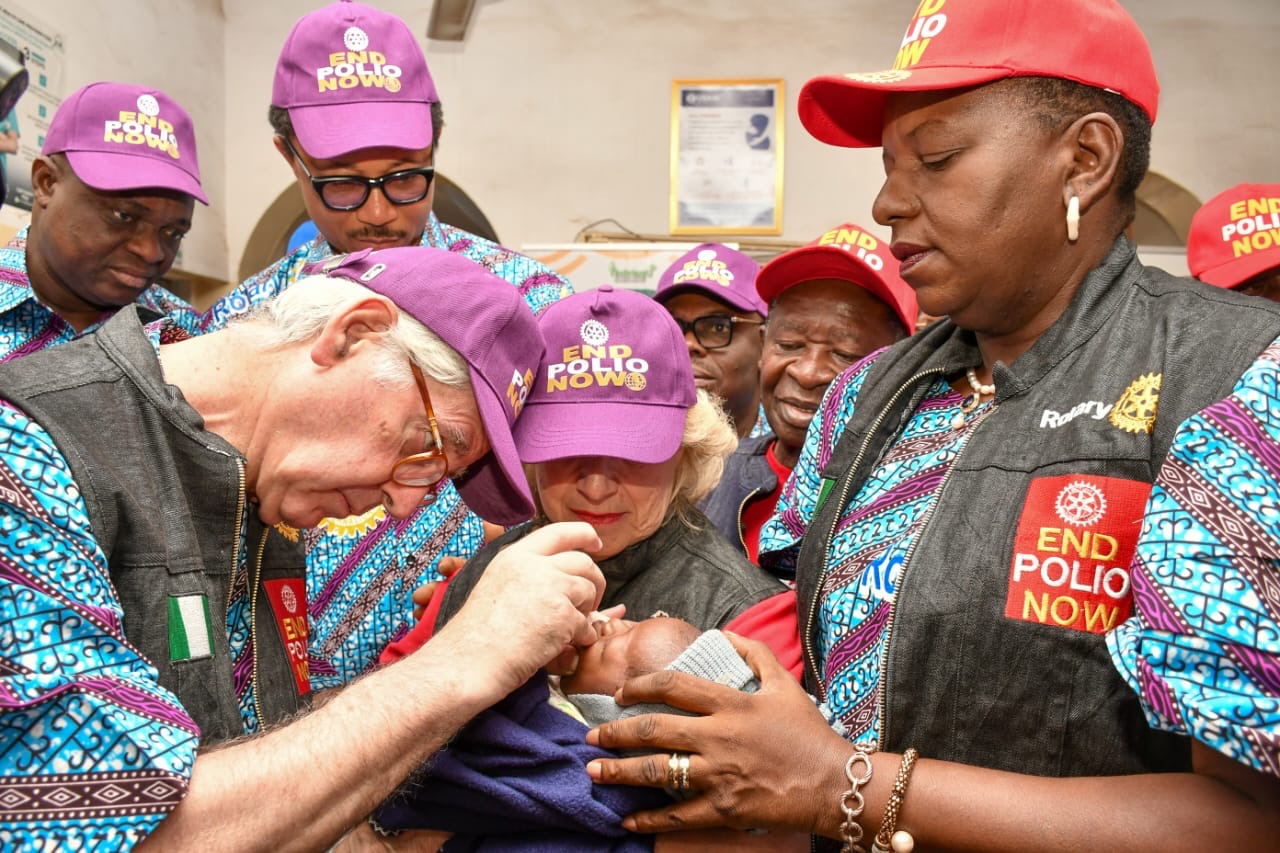
L-R: President Rotary International, Francesco Arezzo, his Wife Anna Maria Francesco Arezzo, Chairman, Nigeria National PolioPlus Committee (NNPPC), PDG Joshua Hassan and Trustee, The Rotary Foundation, Past District Governor (PDG), Ijeoma Pearl Okoro, during the Polio immunisation by the President Rotary International held at Primary Healthcare Care, Area 2 Garki Abuja, yesterday.
He urged the government, stakeholders, and citizens to view polio eradication as a collective public health responsibility.
He called on the Nigerian government and partners to maintain cooperation and ensure every child is immunised.
He said the failure to complete the campaign could put future generations at risk of renewed outbreaks.
He said: “Eradication of Polio is possible, though not easy. The response is straightforward. First, we must continue using the new, more stable vaccine, which significantly reduces vaccine-derived cases.
“Second, we must maintain a very high immunisation rate. Vaccine-derived cases occur only where population immunity is low. With high coverage, such cases cannot spread. These are the two key actions required”.
He assured that Rotary would continue to support Nigeria’s polio eradication efforts.
He described the campaign as a global responsibility rather than the undertaking of a single organisation.
“This is not the problem of Rotary alone; it is the problem of humanity,” he said.
Arezzo commended Nigeria’s efforts at making Africa polio free
He said: “You have remained committed to the Polio Plus campaign in Nigeria. Polio was one of the major global health challenges when the eradication effort began in 1975, and even more so when the Global Polio Eradication Initiative was founded in 1985. At the time, some regions of the world were considered extremely difficult to address,” he said.
“Africa was among those regions. India, however, was widely regarded as not just difficult but impossible. Yet cooperation and commitment proved otherwise.
“The work done in Africa was exceptional, and in 2020 the continent was certified polio-free. That achievement was the result of sustained efforts, including here in Nigeria. India, once considered impossible, also achieved polio-free status.
“Today, only two countries remain endemic: Afghanistan and Pakistan. There are still cases of vaccine-derived poliovirus in some parts of the world, including Nigeria, but the numbers are declining”.
Arezzo said the decline in the polio scourge was due to two main factors, including stable vaccine and a high-level of Immunization.
He added: “First, a more stable vaccine has been introduced. In the past, vaccine-derived cases occurred because the weakened virus could mutate in environments where immunisation coverage was low.
“The newer vaccine is more stable, significantly reducing such variations. This is a major step towards eradication.
“Second, maintaining a very high level of immunisation is critical. To eradicate polio completely, at least 90–97 percent of children under five must be immunised. This is essential”.
The Rotary International president also drew attention to the human cost of the campaign, disclosing that 76 people had died in Nigeria since 2012 during polio vaccination exercises, while 382 vaccinators had been killed in Pakistan.
“These are numbers that are very sad to hear. The best way to honour them is to finish this campaign.”
Later at Area 2, Garki, Abuja, where he and his spouse, Anna Maria, administered polio drops to children, Arezzo said Rotary’s focus remained on protecting children through vaccination.
“For us, it is always a great emotion to give the two drops in the mouth of our children, because each child that we vaccinate is one child that will be safe from polio. Every dose represents a step toward the eradication of polio,” he said.
He said sustained community engagement, particularly with mothers, remained central to the campaign’s success.
“The main job is to explain, to convince, to say how important it is. And I am convinced that they understood how important it is for their children,” he said.
Arezzo said the long-term goal was to achieve zero-dose coverage nationwide, noting that while no fixed timeline had been set, efforts were being intensified.
“We don’t want to leave any child without the two drops. Zero dose is our dream, our goal,” he said.
Earlier, the Chairman of the Nigerian National Polio Plus Committee (NNPPC), Joshua Hassan, expressed concern over the emergence of two vaccine-derived polio cases in Kebbi State, as well as the deaths of two volunteers linked to security challenges, which he said remained a major concern.
He also dismissed claims of declining interest among Rotarians, describing the situation as volunteer fatigue rather than unwillingness.
He said Rotarians were volunteers, many of whom were based in urban centres, while vaccination activities were concentrated in rural areas.
Hassan said Rotary was exploring ways to expand its presence in underserved regions, including parts of the North-East, while relying on volunteers and health workers to sustain immunisation drives.
He stressed that ending polio remained Rotary International’s top priority. “We are 99.9 per cent done, and we must finish the job,” he said.
Also speaking, 9127 District Governor, Princess Joy Okoro, said the visit was to assess Nigeria’s use of global grants and reaffirm Rotary’s commitment to eradication.
“We are still fighting polio to make sure that the poliovirus is totally eradicated in Nigeria, advocacy would be strengthened in states with emerging vaccine-derived cases,” she said.





From Adeko Ukpa, Abuja
The Rotary Foundation, on Wednesday, reaffirmed its commitment to sustaining Nigeria’s polio-free status and reducing maternal and child mortality across the country, describing the efforts of Nigerian Rotarians and health workers as vital to global health.
Speaking during a Community Dialogue and Joint Partners Health Outreach organised by Rotary International in Gwarinpa Village, Abuja, the Chairman of the Rotary Foundation Board, Holger Knaack, said although Africa was certified polio-free five years ago, continued vaccination remains necessary until the disease is completely eradicated worldwide.
Knaack said: “Rotary’s goal is to eradicate polio, to kick it out of the world.
“As long as there are single cases in Pakistan and Afghanistan, we must continue vaccinating children.
“Even though Africa has been free of wild polio-virus for five years, our children are not safe until every child everywhere is protected.”
He emphasised that every newborn in Nigeria must continue to receive polio immunisation to ensure the virus never resurfaces.

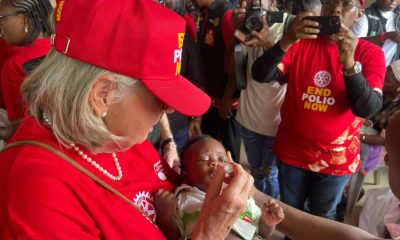
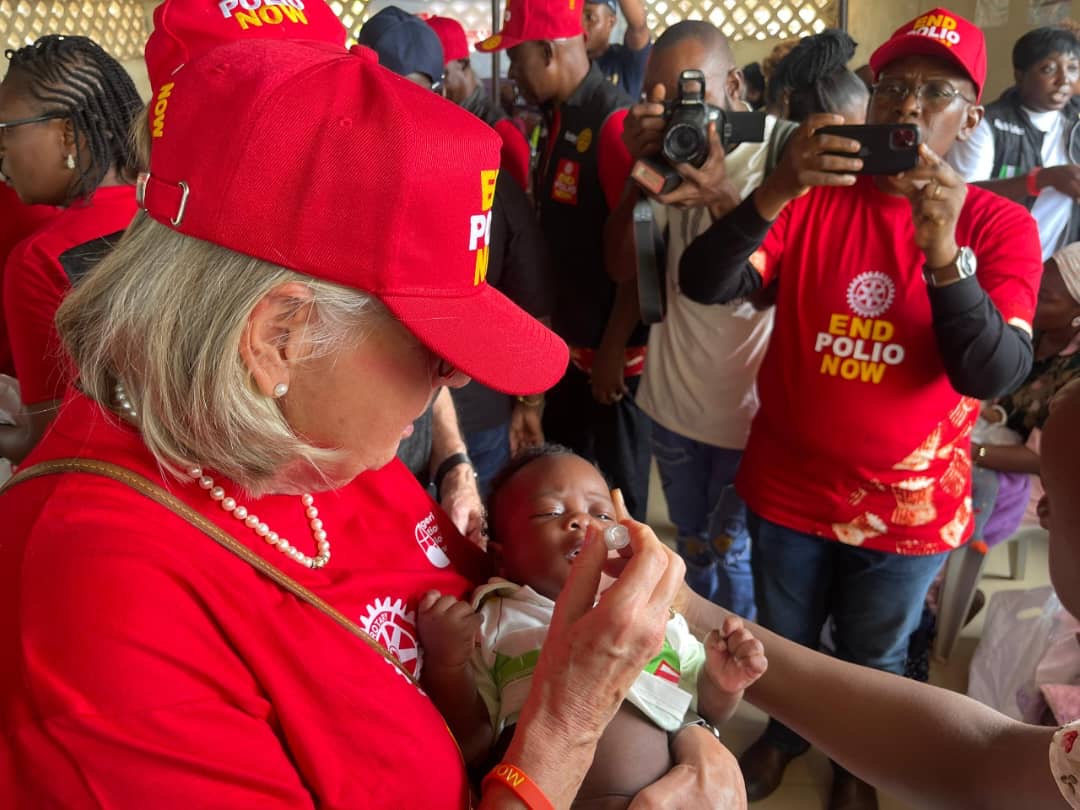
The wife of the Chairman of The Rotary Foundation, Suzanne immunizing a child against polio at AMAC Health Centre, Lugbe in Abuja.
Knaack, who is also visiting other countries, said Nigeria remains central to Rotary International’s global health programmes because of its scale and impact.
“Three of our major projects are happening here in Nigeria – the polio eradication campaign, the ‘Together for Healthy Families’ initiative aimed at ensuring safe childbirth and reducing maternal and child deaths, and the Rotary Healthy Community Challenge, which targets malaria, diarrhoea and pneumonia – the three biggest killers of children,” he said.
He commended Nigerian philanthropist Sir Emeka Offor for his $5 million donation to Rotary’s maternal and child health programmes, describing the support as “outstanding.”
“I want to thank all Nigerians and all Rotarians for fighting against maternal and child deaths.
“What happens here shows donors in Europe and the United States that their contributions are making real impact. It is an investment in global health,” Knaack said.
Also speaking, Trustee of the Rotary Foundation, Dr. Ijeoma Pearl Okoro, said Rotary’s maternal and child health project has already reduced mortality by 28 percent in three years across four pilot states of Ekiti, Nasarawa, Gombe, and the FCT.
“Our goal is that no mother or child should die during childbirth.
“We are expanding the programme to 10 states next year, thanks to the support from the Sir Emeka Offor Foundation,” she said.
Rotarian Okoro noted that Rotary’s interventions begin before conception and continue until a child turns five years old, adding that collaboration with traditional rulers, health workers, and community members has been key to success.
“Community cooperation is everything. You can see the health workers, the mothers, and traditional leaders participating, it’s because they’ve seen results,” she explained.
She urged the media and government to intensify awareness campaigns on immunisation, saying communication and community engagement remain the most powerful tools against polio.
“Even though wild polio-virus has been eradicated from Nigeria, it still exists in Pakistan and Afghanistan and because Nigerians travel everywhere, polio anywhere is polio everywhere. We must not relax until it’s wiped off the face of the earth,” she said.
Also, the Village Head of Gwarinpa Village, Alhaji Umar Bayaro emphasised the importance of polio immunisation to the health of the Community.
He pledged to continue to work with the Rotary International to sustain their interventions in the community.
He said: “My hope is to continue encouraging my people to visit the Primary Health Care Centre.
“Taking the polio vaccine is essential for preventing certain illnesses in our society, and this goal can only be achieved when community leaders are actively involved.
“I am fully committed, alongside other leaders here today, to ensuring that our people participate and benefit.
“I will always support any organisation that brings development projects to my community. I will stand with them to ensure success.
“I also want to urge the Rotary Club not to forget to come back, sustainability is my priority.
“We will continue to sustain whatever has been put in place in this community, and that is why you can already see the positive changes happening here.”
Rotary International has been at the forefront of the global polio eradication effort for over three decades, partnering with the World Health Organization (WHO), UNICEF, and the Bill & Melinda Gates Foundation.
From Adeko Ukpa, Abuja
The Rotary Foundation on Monday reaffirmed its commitment to improving maternal and child health in Nigeria through the Together for Healthy Families in Nigeria programme.
Speaking after an interactive session with the Rotary action group for Reproductive, Maternal and Child Health (Rotary-RMCH)
regarding the ongoing “Together for Healthy Families in Nigeria” programs of scale in Abuja, the Chair of the Rotary Foundation, Holger Knaack, who was accompanied by his wife Suzanne, described the programme as one of its most impactful initiatives on the African continent.
He expressed delight at the progress recorded under the programme, which has significantly reduced maternal and child deaths in participating communities.
“What we are seeing here is the result of more than 25 years of hard work and collaboration among Rotarians, the Rotary Foundation, volunteers, and government health officials,” he said.
“Together, we have achieved a significant reduction in maternal and child mortality. That is the true impact of partnership,” he added.
He explained that Rotary’s approach is to focus on large-scale, measurable projects that deliver lasting change.
“Our goal is always impact. It’s not just about doing good, but about doing the right thing and being able to measure it. Bigger projects have greater, measurable results,” he said.

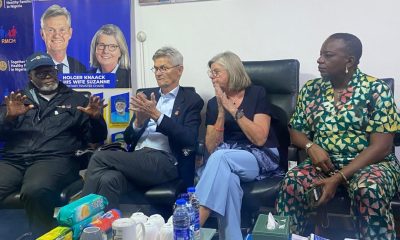
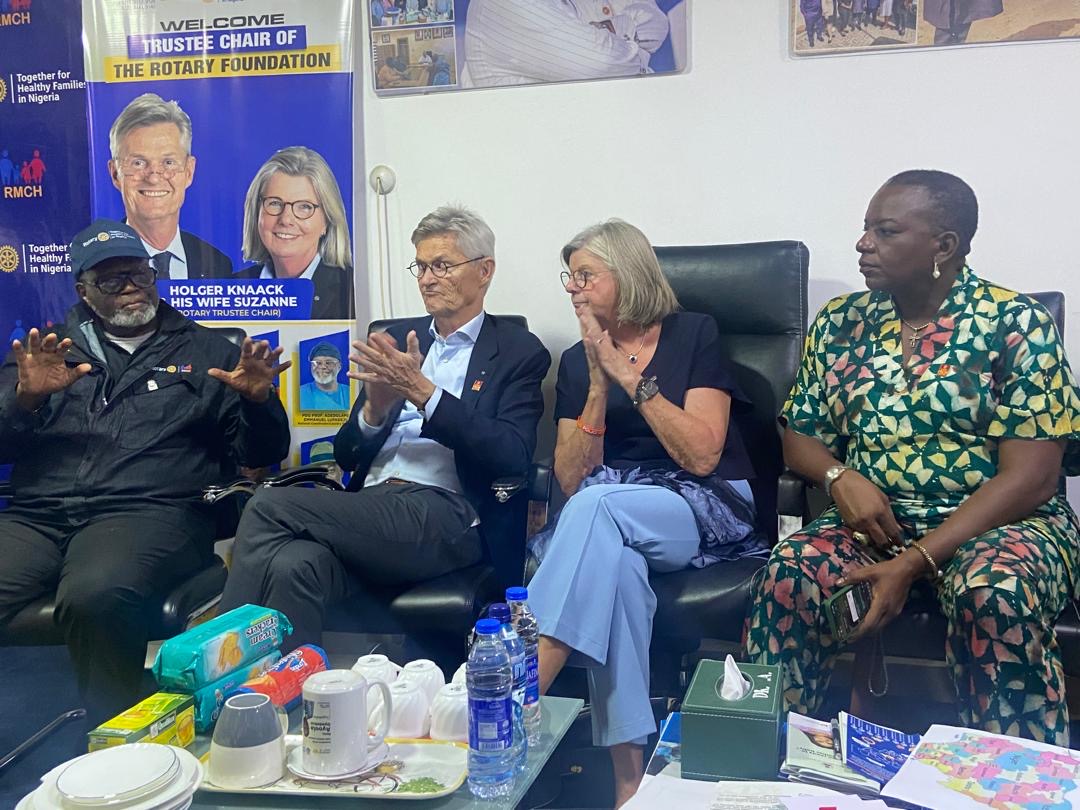
Caption: L-R: The National Coordinator/Country Director of the Together for Healthy Families in Nigeria programme, Prof. Adedolapo Emmanuel Lufadeju, Rotary Foundation Chairman and Past Rotary International President, Holger Knaack,
his wife, Suzanne and Rotary Foundation Trustee, Ijeoma Pearl Okoro, at the maternal and reproductive health review meeting by The RotaryFoundation in Abuja on Monday.
The Together for Healthy Families in Nigeria programme, he noted, is a $2 million initiative that has attracted further support and collaboration.
“Through partnerships with other countries such as Germany, we have raised about $2.8 million, bringing the total investment to nearly $5 million.
“We are also proud that the Sir Emeka Offor Foundation has pledged another $5 million over the next few years to sustain this success,” he said.
Also speaking, Trustee of the Rotary Foundation, Ijeoma Pearl Okoro, described it as a milestone for Nigeria, being only the second Programme of Scale approved by the Rotary Foundation globally.
“I’m happy it came to Nigeria, and that we hit the ground running. We’re already recording successes in maternal and child care,” she said.
“Most importantly, the programme has attracted a scaling partner, which will help us expand beyond the initial four pilot locations.
“The next phase has been mapped out, and we’re ready to extend to other states,” Okoro added.
The National Coordinator/Country Director of the Together for Healthy Families in Nigeria programme, Prof. Adedolapo Emmanuel Lufadeju, in his presentation, said that the Together for Healthy Families in Nigeria programme of Scale (PoS) is an initiative through which Rotary members show their commitment to improving maternal and infant health by providing mothers and newborns with targeted healthcare.
He said the programme has helped in “improving the systemic access to life saving services which will have an immediate and enduring impact on not just mothers but also the wider community by reducing maternal and neonatal mortality in Nigeria, hence the theme.”
“The overall objective of the programme is to scale-down maternal and neonatal mortality by 25%,” he added.
The programme, according to him, commenced implementation in four locations in November 2022.
He listed the locations to include, FCT (Abuja Municipal Area Council), Nasarawa (Akwanga and Lafia LGAs), Gombe (Gombe and Yamaltu Deba LGAs) and Ekiti states (Ado-Ekiti and Ijero LGAs) in 49 facilities in total.
“Owing to the success recorded, as at July 2025, the programme has expanded to 103 facilities across the four locations,” he said.
END

From Adeko Ukpa
Rotary International has spent $3 billion in the fight against poliovirus globally, Michael McGovern, Chair of the Rotary International Polio Plus Committee, has revealed.
The Rotary International Chief, who reaffirmed the organization’s commitment to eradicating polio in Nigeria, urged the Nigerian government and other stakeholders to remain steadfast in prioritizing polio eradication efforts.
Speaking on Tuesday at the Masaka Primary Health Center in Nasarawa State, where he participated in a symbolic polio immunization exercise, McGovern emphasized the importance of continued efforts to protect children from the devastating effects of polio.
“Over the years, we have invested nearly $3 billion. It’s a lot of money, but we are happy to do it because we see the benefit, 20 million children who have not been disabled.
“The biggest impression that everyone has to have here is to see the beautiful children and recognize the importance of their health.
“Ensuring they receive necessary immunizations is vital for them to live healthy lives,” he said.
Despite significant progress, he noted that Nigeria remains at risk, with cases of vaccine-derived poliovirus still being recorded, saying, “While the cases aren’t huge in number, they are crucially important in terms of eradicating this sad, sad disease once and for all”.
He stressed the importance of routine immunization to prevent a resurgence, saying, “The most responsible thing is for everyone to support all routine immunizations, for measles, polio, and many other diseases.
“Immunization strengthens the immune system and protects children from multiple illnesses, not just polio”.
McGovern, however, acknowledged the tireless work of frontline health workers, who venture into difficult terrains to ensure that children receive vaccines.
“We particularly want to acknowledge the frontline workers who go out into the heat, into so many places, and the mothers who make sure their children are immunized.
“It’s life-saving. It makes a difference,” he noted.
McGovern also recognized the contributions of international partners such as the World Health Organization (WHO), United Nations Children’s Fund (UNICEF), Gavi the Vaccine Alliance, and the Bill & Melinda Gates Foundation, but emphasized the critical role of local communities, noting, “In the end, it’s the local communities that make the difference, ensuring children are immunized and have a healthy future”.
He also underscored the importance of health surveillance, saying, “Laboratories, parents, and local health authorities must remain vigilant. If a child shows signs of illness, parents should take them to health facilities to find out what is going on”.
On Nigeria’s broader immunization efforts, he noted that all countries, including his home country, the United States, could do more, “Nigeria is not unlike the rest of the world. Every country can do more than it is doing now,” he stressed.
However, McGovern reiterated that while polio eradication remains a priority, Rotary International is also committed to supporting broader child and maternal health initiatives.
“The next big project will be determined by Rotarians worldwide. We don’t prescribe top-down solutions; we listen to the needs of local communities,” he said.
Carol Pandak, Director of the Polio Plus Program at Rotary International, echoed McGovern’s sentiments, urging Nigerian communities to prioritize vaccinations.
“I’ve been very impressed with the mothers, children, and the dedication of local health workers.
“The most important thing parents can do is immunize their children, not just against polio but against all vaccine-preventable diseases,” she said.
-

 Opinion12 months ago
Anioma State: A Necessary Proposal Rooted in Strategic Advantage
-
 Business & Economy1 year ago
NASENI, Qietur partner to build 3000 Housing Units for Staff
-
 Business4 months ago
Lithium boom has reshaped Nasarawa’s economy, says Prof Haruna
-
 Law2 years ago
Human Right and Law Enforcement in Nigeria: A Critical Analysis
-

 Education5 months ago
NABTEB Registrar advises automotive, locomotive Engineers to do more to diversify Nigerian economy
-
Education8 months ago
TVET will change Nigeria for good, says NABTEB Registrar
-
 Opinion5 months ago
Engr. Kawu: A Heroic Homecoming for a Man of the People
-
 Education8 months ago
TVET: FG conducts entrance exam into FTCs for 30,000 students