
News
District Governor-Elect, Owonikoko, charges Rotary leaders on public image, membership, foundation giving


By Adeko Ukpa, Abuja
District Governor-Elect of Rotary International District 9127, Sikiru Adetona Owonikoko, has urged Rotary leaders to humanise the organisation’s public image, strengthen membership engagement and strategically deploy resources from The Rotary Foundation to drive measurable community impact.
Delivering an address at the District Learning Seminars in Abuja, Owonikoko said Rotary’s reputation must be built on people and stories of service rather than corporate branding.
“You are the face of Rotary. Not the wheel. Not the banner. Not the slogan. You,” he said.
“People do not connect with institutions. They connect with people of action.”

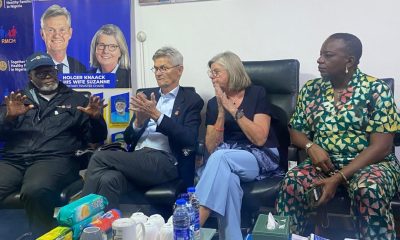
L-R: District Governor, Rotary International D9127, Dame Joy Nky Okoro; Hajiya Zainab Owonikoko; District Governor-Elect, Rtn. Sikiru Adetona Owonikoko; Trustee, The Rotary Foundation, Past District Governor (PDG), Ijeoma Pearl Okoro; and PDG Victor Onukwuga, during the opening ceremony of the Rotary International, District 9127 Leaning Seminar 2026, held at the Nigerian Army Resource Centre in Abuja, yesterday.
He encouraged clubs to document and publicise tangible community interventions, including education support, health initiatives, youth mentoring and women empowerment.
“Rotary’s public image must be built around real faces, real names, and real stories of impact,” he said.
On The Rotary Foundation, Owonikoko described it as the “engine that powers the Rotary wheel of impact,” noting that it recently raised over $417million to fund projects globally.
“When we give to The Rotary Foundation, we are not giving money away. We are investing in hope, dignity, and humanity,” he said.
He also emphasised membership growth, retention and engagement, arguing that belonging and recognition are critical to sustaining Rotary’s membership base.
“People stay where they are seen. People grow where they are valued,” he said, adding that each Rotarian could expand the organisation by inviting at least one new member.
Owonikoko further called for open and transparent communication among Rotary leaders and members.
“When communication flows, trust grows. When trust grows, collaboration strengthens. And when collaboration strengthens, impact multiplies,” he said.
He charged leaders to listen to members, share information freely and foster unity across clubs and district structures.
The District Governor-Elect also urged leaders to embrace bold leadership, innovation and service in order to “create lasting impact” during the 2026–2027 Rotary year.





By Adeko Ukpa, Abuja
Plateau State Governor, Barrister Caleb Manasseh Mutfwang, has embarked on a strategic economic, development and bilateral trade mission to the United States, aimed at attracting investments and deepening sub-national international cooperation in line with the Federal Government’s Renewed Hope Agenda.
The governor arrived in the U.S. to engage key American institutions, including the United States Development Finance Corporation (DFC), the United States Export-Import Bank (EXIM), senior officials of the U.S. State Department, as well as other policy and investment stakeholders, to explore opportunities that will boost economic growth, trade and development in Plateau State and Nigeria.
According to him, the visit underscores Plateau State’s commitment to expanding its international footprint and leveraging global partnerships to drive sustainable development and prosperity for its people.
 As part of his early engagements, Governor Mutfwang met with U.S. Congressman Riley Moore, where discussions centred on strengthening the growing Nigeria–United States partnership, particularly in the areas of economic cooperation, investment, security and democratic governance.
During the meeting, the governor highlighted the Renewed Hope Agenda of President Bola Ahmed Tinubu, GCFR, which he said prioritises the welfare, security and prosperity of Nigerians. He also noted the progress being made in tackling insecurity across the country, attributing recent gains to the President’s decisive leadership and firm commitment to national security.
Governor Mutfwang said the improving security situation is creating a more conducive environment for investment and economic growth, both at the national and sub-national levels.
In his response, Congressman Moore commended the Plateau State governor for the visit and expressed strong interest in deepening U.S.–Nigeria relations. He reaffirmed his commitment to working with the Nigerian government to promote a comprehensive and mutually beneficial partnership between both countries.
Governor Mutfwang thanked the U.S. Government and Congressman Moore for their continued support, assuring them of Plateau State’s readiness to strengthen cooperation in investment, development, security and people-to-people relations.
From Adeko Ukpa
Former Deputy National Publicity Secretary of the All Progressives Congress (APC), Comrade Timi Frank, has described the conferment of the Grand Commander of the Order of the Niger (GCON) on businessman Gilbert Chagoury as a dark moment for Nigeria, warning that the decision sends a dangerous signal that corruption and conflicts of interest are being normalised at the highest levels of power.
In a strongly worded statement, Frank said the honour – Nigeria’s second-highest national award – undermines public trust and the country’s anti-corruption posture, given widely reported allegations and judicial findings linking Chagoury to money-laundering cases arising from funds looted during the late General Sani Abacha junta.
“Today ranks among the saddest days of my life as a Nigerian,” Frank said, recalling reports that a Swiss court convicted Chagoury in 2000 in connection with laundering Abacha loot, after which he allegedly paid a fine of one million Swiss francs and returned about $66 million to the Nigerian government.
“To bestow one of our highest national honours on a person publicly tainted by allegations and judicial findings of corruption sends a deeply troubling message about our national values,” he added.
Frank also raised concerns about alleged conflicts of interest, citing reports that Chagoury is a business associate of President Bola Ahmed Tinubu and is linked to the controversial Lagos–Calabar Coastal Highway project, reportedly awarded without competitive bidding to Hitech Construction Company, a subsidiary of the Chagoury Group.
“A sitting President should not be in business dealings – directly or indirectly – with close associates while holding office,” Frank said, arguing that the optics of the award and the project fuel public suspicion of abuse of power.
The former APC spokesman further pointed to what he described as troubling institutional contradictions, noting that Nigeria’s current National Security Adviser, Nuhu Ribadu, once served as chairman of the Economic and Financial Crimes Commission (EFCC) under former President Olusegun Obasanjo, when Chagoury was reportedly investigated as one of Abacha’s key cronies.
Frank who currently serves as the United Liberation Movement for West Papua (ULMWP) Ambassador to East Africa and the Middle East as well as Senior Advisor to the Global Friendship City Association (GFCA), USA,
claimed that Chagoury left Nigeria at the time, only to return later after settling fines and returning funds.
He also referenced reported issues Chagoury allegedly had with United States authorities over money-laundering allegations, though later settled, arguing that such a history should preclude elevation to national honour and international legitimacy.
Expanding his critique to the international arena, Frank cautioned the United States – particularly President Donald Trump and American policymakers – against being misled by lobbyists or vested interests.
He warned that Washington should not appear to lend moral or political cover to individuals or governments perceived to reward corruption.
“A President reputed for standing against corruption and poor governance should be cautious about associating, directly or indirectly, with a government that glorifies individuals with controversial corruption histories,” Frank said.
He also alluded to persistent claims that Chagoury exerts outsized influence over major infrastructure and commercial decisions in Nigeria, allegedly to the detriment of American business interests and in favour of French-linked firms.
If true, Frank said, such claims raise serious questions about transparency, fair competition and the capture of state policy by private interests.
“Nigeria should not become a theatre where corruption is rewarded, conflicts of interest are ignored, and foreign influence is leveraged against national and allied economic interests,” he warned, adding that the controversy has international governance implications.
Frank criticised what he described as a growing disconnect between government decisions and public sentiment, arguing that transparency and accountability are increasingly sidelined.
He questioned the criteria used to confer the GCON on Chagoury, asking Nigerians to demand clarity on his contributions to national development.
“What hospitals, schools or scholarships has he built or funded to merit this honour?” Frank asked. “Beyond his name being linked for years to alleged corruption cases without clear conclusions, Nigerians deserve to know what qualifies him for this award and who among our business leaders has been similarly honoured.”
Calling for civic vigilance, Frank urged opposition parties and citizens committed to justice and the rule of law to treat the episode as a wake-up call.
“A nation where individuals accused or convicted of corruption are protected, defended or even honoured is a nation drifting dangerously toward institutionalised impunity,” he said.
“It is one thing for the rule of law to be weakened; it is far worse for impunity to be openly rewarded.”
Frank urged reflection and decisive action, insisting that Nigeria must recommit to accountability and ethical governance. “Nigeria deserves better,” he said.
Crime
Arms Allegation: Timi Frank Urges Tinubu to Probe Ribadu, Kwara Gov AbdulRasaq …Says Conflicting Accounts on Kwara Arms Show ‘Dangerous Sabotage’, Security Cover-Up

From Adeko Ukpa, Abuja
A political activist and former Deputy National Publicity Secretary of the All Progressives Congress (APC), Comrade Timi Frank, on Friday, called on President Bola Ahmed Tinubu to order an immediate and independent investigation of the National Security Adviser (NSA), Mallam Nuhu Ribadu, and the Governor of Kwara State, AbdulRahman AbdulRasaq, over allegations of arming Fulani bandits and other non-state actors in the state.
Frank also urged the United States government to impose visa bans on the two officials and to exercise caution in sharing intelligence with Nigeria until the controversy is fully investigated.
In a statement issued in Abuja, Frank described the unfolding situation as “a chain of official contradictions, confessions, denials and reversals” which, according to him, has exposed “dangerous fault lines within Nigeria’s national security architecture.”
The controversy followed the interception by Nigerian soldiers of armed men carrying AK-47 rifles and operating in a patrol vehicle reportedly linked to the Kwara State Government in Ifelodun Local Government Area.
The arrested men were said to have claimed that the state government provided them with the arms and vehicle.
Frank noted that shortly after the incident, officials of the Kwara State Government publicly confirmed that the arrested men were members of Miyetti Allah, allegedly operating under a federal security arrangement coordinated by the Office of the National Security Adviser (ONSA).
“Barely days after initial denials, the Kwara State Government itself confirmed that the arrested individuals were part of a security operation linked to the NSA’s office,” he said.
According to Frank, the matter became more troubling when a statement from the NSA’s office initially acknowledged that arms had been issued to vigilantes as part of so-called “hybrid security operations” under the Terrorism Prevention and Prohibition Act.
“That admission was widely reported and not immediately disputed,” he said.
However, Frank faulted what he described as a “sudden and suspicious U-turn” by the NSA’s office, which later denied arming kidnappers, militias or socio-cultural groups, insisting instead that the armed men were merely “vigilantes known to the NSA.”
“This leaves Nigerians with fundamental questions,” Frank said. “Who authorised the arms? Who recruited these armed men? Why did official accounts change repeatedly within days? Is the Kwara State Governor telling the truth, or is the NSA covering up?”
Describing the situation as a “national security scandal,” Frank said the contradictions could not be dismissed as a media misunderstanding.
“You cannot, as National Security Adviser, first appear to justify or explain the issuance of arms and then turn around to deny it completely. Such contradictions suggest either gross incompetence or a deliberate cover-up to protect powerful interests,” he said.
Frank argued that the incident showed that “top government officials know exactly what is happening and are playing politics with Nigeria’s insecurity,” adding that insecurity was being politicised “within the cabinet, within the government and within the ruling party.”
“When a governor says one thing and the NSA says another, Nigeria is not just confused — Nigeria is endangered,” he added.
He also questioned the deployment of armed Miyetti Allah operatives in Kwara, a predominantly Yoruba area.
“What business do armed Miyetti Allah operatives have operating in Yorubaland under any circumstance?” he asked, noting that communities in the state had repeatedly warned that deploying armed migrant herders would worsen insecurity rather than resolve it.
Frank said that in a “sane country,” Ribadu would have stepped aside to allow a transparent investigation, rather than what he described as “evasions, reversals and damage control.”
Calling directly on President Tinubu, Frank said: “The President must immediately order a full, independent probe into the roles of the NSA and the Kwara State Government, investigate the conflicting briefings from the NSA’s office, and punish any official found to have armed or enabled non-state actors outside the law.”
He warned that the contradictions suggested “that someone is lying — or many people are hiding the truth,” and amounted to internal sabotage of the administration.
Frank also appealed to the United States to be cautious in its dealings with Nigeria’s security leadership.
“America must withhold sensitive intelligence sharing, launch its own investigation into these allegations, and impose visa bans on Mallam Nuhu Ribadu and Governor AbdulRahman AbdulRasaq pending the outcome of credible investigations,” he said.
According to him, “when a country cannot tell the truth about who is armed, who authorised it, and who is responsible, that country cannot be trusted with shared intelligence.”
Frank who currently serves as the United Liberation Movement for West Papua (ULMWP) Ambassador to East Africa and the Middle East as well as Senior Advisor to the Global Friendship City Association (GFCA), USA,
lamented that the controversy underscored a deeper crisis.
“Nigeria’s insecurity is no longer just about bandits and kidnappers — it is about deception, politics and betrayal at the highest levels of government,” he said, warning that history would judge Tinubu’s administration harshly if decisive action was not taken.
-
 Opinion11 months ago
Anioma State: A Necessary Proposal Rooted in Strategic Advantage
-
 Business & Economy1 year ago
NASENI, Qietur partner to build 3000 Housing Units for Staff
-
 Law2 years ago
Human Right and Law Enforcement in Nigeria: A Critical Analysis
-
 Business4 months ago
Lithium boom has reshaped Nasarawa’s economy, says Prof Haruna
-
 Education5 months ago
NABTEB Registrar advises automotive, locomotive Engineers to do more to diversify Nigerian economy
-
Education8 months ago
TVET will change Nigeria for good, says NABTEB Registrar
-
 Opinion5 months ago
Engr. Kawu: A Heroic Homecoming for a Man of the People
-
 Education8 months ago
TVET: FG conducts entrance exam into FTCs for 30,000 students